


The public is overwhelmed with claims that evolution is a fact—from the classrooms to the courts and clergy. The late S. J. Gould even likened evolution to gravity:
Facts do not go away when scientists debate rival theories to explain them. Einstein’s theory of gravitation replaced Newton’s, but apples did not suspend themselves in mid-air, pending the outcome. And humans evolved from apelike ancestors whether they did so by Darwin’s proposed mechanism or by some other, yet to be discovered.1
In past decades, secularists, alarmed by the rise of those who question the unobserved idea of vertical evolution—as opposed to the minor horizontal changes that can be observed—have responded with panic. Television programs, educational supplements, and imaginative museum displays have all beat the drum defending the people-from-bacteria philosophy.
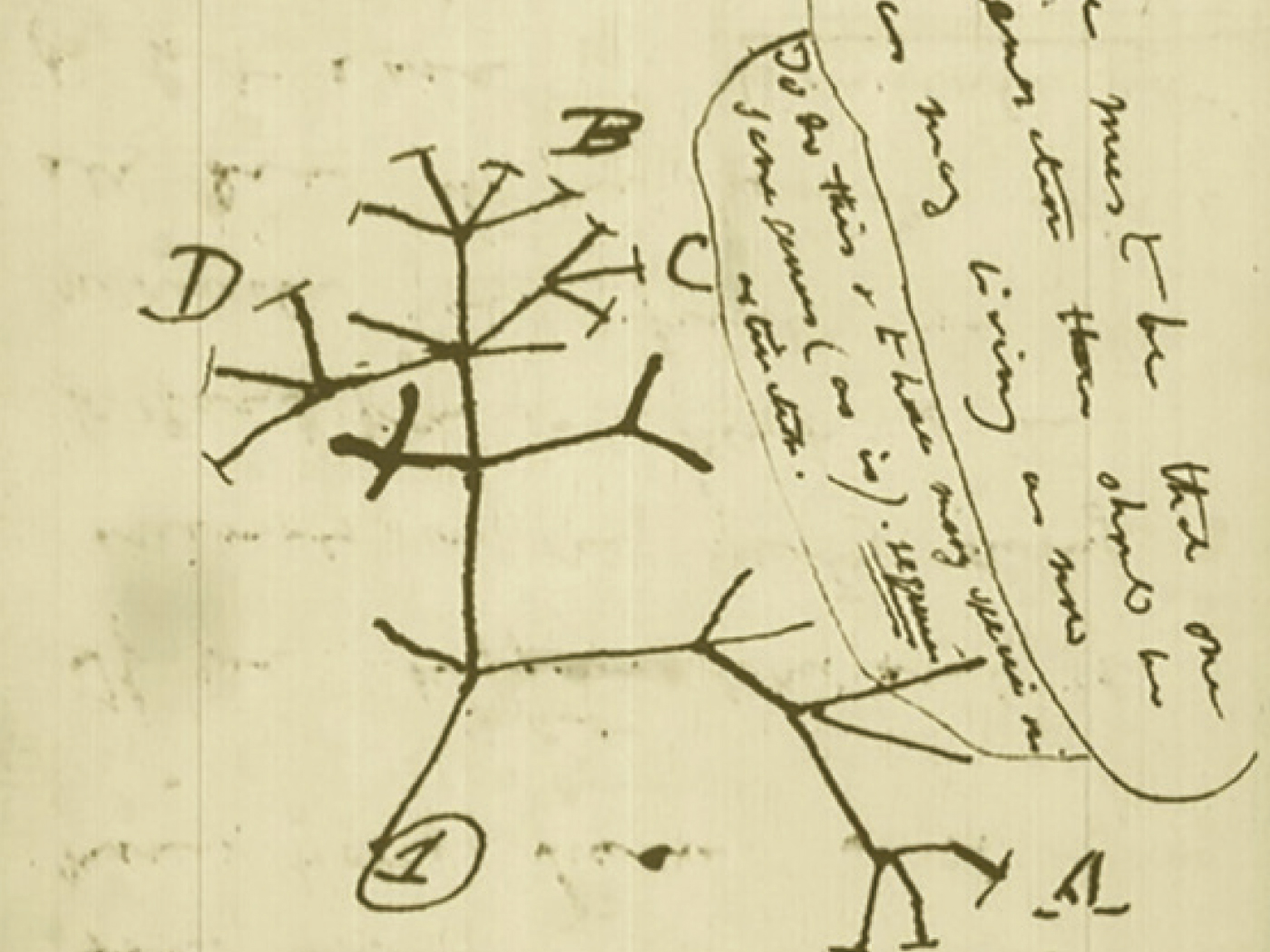
Michael Ruse wrote a book in 1982 titled Darwinism Defended2 in which he made the point that minor variation can be observed and measured. Indeed, the cover of Ruse’s book shows the finches Darwin found on the Galapagos Islands that expressed minor variation. But this is clearly not what vertical evolution is, or what the origins debate is all about. It’s not about going from small to large beak; it’s about going from no beak at all to having a beak. Such large change is vertical or “macro” evolution—or, as Darwin described it, descent with modification.
The Subject Index of Ruse’s book shows pages 210 to 228 as covering the word “macroevolution.” But pages 227 and 228 are either blank or just have the title of the book’s next section. That leaves the reader with 15.5 pages, or less than 5 percent of a 356-page book, to defend Mr. Darwin’s strange idea. Though only 5 percent of the book actually addresses the title subject, this is more than what Darwin accomplished in Origin of Species, which not one time addressed how species originated.
Ruse showed a diagram (Figure 9.7) of a “clade” that presupposes macroevolution, and minor change in the diameter of the foraminiferan Lepidolina (Figure 9.8)—but it’s still Lepidolina. Ruse makes much of corn (maize) variation (Figures 9.9 and 10)—but it’s still corn, and fruit flies remain fruit flies (Figure 9.11).3
The defense for macroevolution hasn’t changed much. In 2001 a husband/wife team wrote the even more shrill and vitriolic Defending Evolution.4 Its index showed that three pages, or just over 1 percent, of their 246-page book was dedicated to the root question: macroevolution. And those pages offer no facts of macroevolution. Instead, the couple used a logical fallacy called “begging the question.” They wrote, “Likewise, humans did not directly observe the evolution of the dinosaurs, but their evolution is nonetheless considered to be scientific fact.”5 But this presupposes that vertical evolution occurred—in a book dedicated to defending vertical evolution!
Meanwhile, a 2011 Science magazine article stated:
The demise of T. rex and most other dinosaurs some 65 million years ago may grab all the headlines. But paleontologists are equally concerned with puzzling out how these mighty beasts got their start. Who were their ancestors?6
To summarize, the best defense is a good offense. A convincing defense of evolution need only list fact after documented fact of macroevolution (“descent with modification”), chapter after chapter, in each field of biology. Instead, we find examples of minor variation coupled with lengthy attacks on those who question vertical evolution. That is no way to defend a “fact.”
Reference
- Gould, S. J. 1981. Evolution as Fact and Theory. Discover. 2: 34-37.
- Ruse, M. 1982. Darwinism Defended: A Guide to the Evolution Controversies. Reading, MA: Addison-Wesley Publishing Company.
- See also Burke, M. K. et al. 2010. Genome-wide analysis of a longterm evolution experiment with Drosophila. Nature. 467 (7315): 587-590.
- Alters, B. J. and S. M. Alters. 2001. Defending Evolution in the Classroom: A Guide to the Creation/Evolution Controversy. Sudbury, MA: Jones and Bartlett Publishers, Inc.
- Ibid, 119.
- Balter, M. 2011. Pint-Sized Predator Rattles the Dinosaur Family Tree. Science. 331 (6014): 134.
* Mr. Sherwin is Research Associate, Senior Lecturer, and Science Writer at the Institute for Creation Research.
Cite this article: Sherwin, F. 2011. Defending a "Fact." Acts & Facts. 40 (12): 18.