


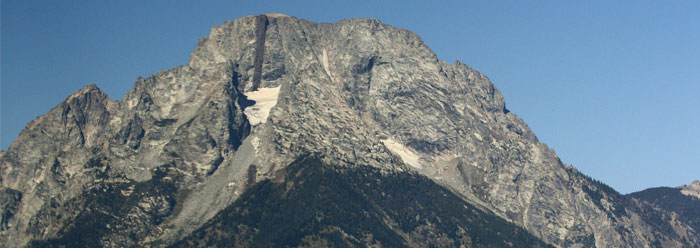
Mount Moran, the nonconformist of Wyoming's Teton Range, is distinguished by having a blunt top, a prominent black vertical stripe on its upper part, and a tiny visible cap of marine sandstone on the summit. Its face is made of the same solid granitic stock as comprises the core of the other mountains of the Teton Range, but it differs in other respects. How does this beautiful mountain testify of Creation and the Flood?
First, the core of Mount Moran is comprised of crystalline basement rocks, the same types that make up most of the core of North America. If you drill deep enough in most places on the continent you will find these rocks. Although granitic in overall composition, most of the basement complex consists of metamorphic and igneous rocks that appear to be in crosscutting relationship with one another and which seem to indicate a long history of complex intrusive events. However, these relationships are not nearly as clear as the margins of true intrusive bodies such as the Sierra Nevada Batholith, where adjacent fossil-bearing sedimentary rocks were obviously cooked by the heat of the enormous magma body.
Is it conceivable that the patchwork basement of metamorphic and igneous rocks presents the appearance of a long history of melt, intrusion, and recrystallization, yet the entire body was created instantly? Is it possible these represent the collective work of Day One of the Creation Week? One thing is certain: it is easy to identify rocks like these as forming the core of most of the earth's continents.
Second, there is the peculiar black dike that from a distance looks like a vertical line made by a giant, broad, felt-tipped pen. In this case, the dike is about 150 feet in width, and diabase in composition. Diabase dikes are not uncommon in the rock record, but they are an especially common feature of the "late Precambrian" worldwide and may mark a unique episode in earth history when vertical cracks were opened and infilled with mafic (iron/magnesium-rich, quartz-poor) magma. It was emplaced sometime before the erosion surface known as "the Great Unconformity" was generated, yet after formation of the crystalline basement rocks.
Scripture indicates the Flood began when "all the fountains of the great deep |were| broken up |literally ‘faulted'|" in a single day (Genesis 7:11). Could these dikes such as exist atop Mount Moran mark an episode of worldwide tectonic unrest immediately prior to the start of the Flood? The evidence certainly fits with this.
Third and finally, there is what appears to be a tiny wisp of a light-colored cap atop Mount Moran, as if it needed to keep its head warm. The cap is in fact a remnant (the Flathead Sandstone) of a vast sheet of sandstone that once covered the continent like a layer of plastic wrap across a football field. The Flathead Sandstone is the basal part of an entire succession of marine fossil-bearing strata that tilt westward away from the axis of the Teton Range but which are mostly out of view from the floor of Jackson Hole. Geologists universally regard the Flathead Sandstone as the basal layer of a "marine transgression" that flooded most of the continent beneath seawater. Subsequent to this "flood," the mountain block called the Tetons was uplifted and sculpted by glaciers.
The biblical geologist who believes in the Flood can agree with this story; he questions only the necessity of the extreme timescale. An important question to ask is what scientific evidence forbids the possibility that Creation, the world-covering Flood, and subsequent uplift of mountain ranges like the Tetons, took any longer than several thousand years? Apart from uniformitarian prejudice, there is none.
Many are attracted to scenic places like Mount Moran. These wonders grab our attention for a good reason. Among the things the created world conveys is God's "eternal power" (Romans 1:20). Think about His power the next time you visit the Tetons.
* William A Hoesch, M.S. geology, is Research Assistant in Geology.
Cite this article: Hoesch, W. 2007. Mount Moran: A Witness to the Flood. Acts & Facts. 36 (11): 14.