



"Predictions have value," writes a prominent space scientist about planetary theories. "The classic test of a theory," he says, "is its ability to predict. Successful predictions are so rare that they are usually regarded as compelling evidence in favor of the underlying theory."1 If that is so, then the Voyager II space probe has provided "compelling evidence" in favor of the creationist's theory of the origin of planetary magnetic fields by confirming two of its predictions. A main tenet of consequence of creationist theory is that planetary magnetic fields must be much younger than the billions of years required by evolutionary theory.
The Creation of Planetary Magnetic Fields
In 1984, when no space craft had yet reached Uranus and Neptune, I published a theory predicting the strength of the magnetic fields of those two planets in the Creation Research Society Quarterly, a peer-reviewed creationist scientific journal.2 I made the predictions on the basis of my hypotheses that (A) the raw material of creation was water (based on II Peter 3:5, "the earth was formed out of water and by water"), and (B) at the instant God created the water molecules, the spins of the hydrogen nuclei were all pointing in a particular direction.3 The tiny magnetic fields of so many nuclei would all add up to a large magnetic field. By the ordinary laws of physics, the spins of the nuclei would lose their alignment within seconds, but the large magnetic field would preserve itself by causing an electric current to circulate in the interior of each planet. By the same laws, the currents and fields would preserve themselves with only minor losses, as God rapidly transformed the water into other materials. After that, the currents and fields would decay due to electrical resistance over thousands of years.4 Not all creationists agree with my hypothesis that the original material was water, but all agree that once a magnetic field existed, it would decay over time.
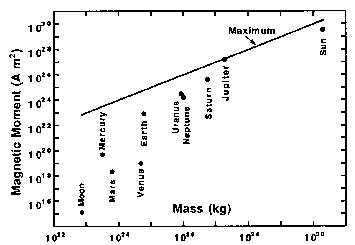 |
The straight line in Figure 1 shows the maximum magnetic dipole moment (a measure of the strength of the magnetic field's source) of each planet at creation, according to my theory. The present-day magnetic moments depend on the size and electrical conductivity of each planet's core and on the age of the solar system. Using accepted models (which are really only guesses) of the cores' and an age of 6,000 years,6 I estimated the present magnetic moments for the Sun, Moon, and all the planets for which we had magnetic data in 1984.2 The values I got agreed well with the measured values shown by the solid dots in Figure 1. In 1984 we had no magnetic data for Uranus and Neptune. I estimated magnetic moments of roughly 2 to 6 x 1024 Ampere-meters2 for both planets. Because of the uncertainty about the interiors of those planets, I widened my prediction to "on the order of'" 1024 A m2, by which I meant that the magnetic moments would be between 1 x 10²³ and 1 x 1025 A m2. And regardless of assumptions about planetary interiors, if the present field of either planet had exceeded the maximum (the line in Figure 1), my theory would have been falsified. There is no definite minimum, but values several orders of magnitude lower than the prediction would cast serious doubt on my theory. Thus I proposed that the Voyager II measurements would be a good test of my hypothesis.
Voyager Tests the Theory
Two years later, on January 20, 1986, Voyager II passed by Uranus. It showed that Uranus has a magnetic moment of 3.0 x 1024 A m2, well within the bounds of my prediction. In contrast, many evolutionists had predicted that Uranus would have a much smaller field, or none at all.7 This prediction grew directly out of their "dynamo" theories, which assume that the fluid interior of a planet is like an electrical generator (dynamo) maintaining the magnetic field forever. The generator mechanism would be driven by heat in the interior, which would manifest itself by a significant heat outflow from the planet's surface. However, astronomic measurements had shown that Uranus has very little heat outflow. Hence, by their theories, Uranus should not have a strong magnetic field. But it does!
On August 25, 1989, Voyager II passed by Neptune and found that it has a magnetic moment of 1.5 x 1024 A m2, again about in the middle of my prediction. Neptune has a significant heat outflow, so dynamo theorists expected it to have a field as strong as the one I predicted. Thus for Neptune, the creationist and evolutionist theories did equally well, as far as predicting the strength of the field is concerned. However, in other aspects of the magnetic field, Neptune gave the dynamo theorists a rude surprise.
Surprise! Tilts and Offsets
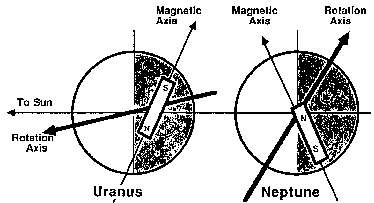
The rotation axis of Uranus lies nearly in the plane of its orbit around the sun. Uranus is thus a planet "tipped on its side." On the other hand, Neptune's rotation axis is more or less perpendicular to the plane of its orbit, as is the case for the rest of the planets. But Voyager discovered that both Uranus and Neptune have two surprising magnetic features in common. First, the magnetic axis of each planet is tilted about 60 degrees with respect to the rotation axis, so that the magnetic poles are near the equator (Figure 2). Second, the source of each planet's field is offset by about one-third of a planetary radius away from the center.
 |
Neither the creation nor the dynamo theory predicted these features. However, it is much more difficult to explain the tilts and offsets with the dynamo theory than it is with the creation theory. According to the dynamo theory, the magnetic and rotation axes should nearly always be closely aligned, except for a very small fraction of the time when the direction of the field is reversing. Thus, when Voyager passed Uranus, pundits explained that the planet is in the rare act of flipping its magnetic field. However, that explanation became highly unlikely when Neptune's magnetic tilt was discovered. One comment was: "Two odd magnetic fields is one too many."8 A creationist explanation could involve the field's source being in the planet's solid core, which could be displaced by accreted material sinking through the vast outer planetary ocean of fluid. Such a displacement could influence both the magnetic and rotational tilt of the planet.9 Dynamo theories cannot consider this possibility because their postulated field-generating mechanism cannot work in a solid.
Significance of the Predictions
The key postulates of my theory come directly from the Bible, as I mentioned above. If the solar system were much older than the Biblical age, the predictions would not fit the observations. But the predictions do fit the observations, thus supporting the Bible and a straightforward creationist understanding of it. In contrast, dynamo theory predictions have fared poorly in the solar system, not only at Uranus and Neptune, but elsewhere, particularly at Mercury, the Moon, and Mars.10 One commentator says, "You would have thought we would have given up guessing about planetary magnetic fields after being wrong at nearly every planet in the solar system. . . ."11
REFERENCES
1. Dessler, A.J. "The Neptune challenge," Geophysical Research Letters, 14 (September 1987), 889.
2. Humphreys, D.R. "The creation of planetary magnetic fields," Creation Research Society Quarterly, 25 (December 1984), 140-149. Available from Creation Research Society, P.O. Box 14016, Terre Haute, Indiana 47803.
3. Humphreys, D.R. "The creation of the earth's magnetic field," Creation Research Society Quarterly, 20 (September 1983), 89-94.
4. Barnes, T.G. "Decay of the earth's magnetic moment and the geochronological implications," Creation Research Society Quarterly, 8 (June 1971), 24-29.
5. Smoluchowski, R. "The interiors of the giant planets-1983," The Moon and Planets, 28 (1983), 137-154.
6. Niessen, R. "A biblical approach to dating the earth: a case for the use of Genesis 5 and 11 as an exact chronology," Creation Research Society Quarterly, 19 (June 1982), 60-66. Uses the Masoretic (Hebrew) text and a "no-gap" chronology.
7. Dessler, A.J. "Does Uranus have a magnetic field?" Nature, 316 (16 January 1986), 174-175. Rossbacher, L. "Voyager II encounters Uranus," Episodes, 9 (March 1986), 17-21.
8. Kerr, R.A. "The Neptune system in Voyager's afterglow," Science, 245 (29 September 1989), 1450-1451.
9. Humphreys, D.R. "Good news from Neptune: The Voyager II Magnetic Measurements," Creation Research Society Quarterly (1990), in press.
10. Parker, E.N. "Magnetic fields in the cosmos," Scientific American, 249 (August 1983), 44-54, see p. 52. Hood, L.L. "The enigma of lunar magnetism," EOS, 62 (21 April 1981), 161-163. See also Reference 2.
11. Bagenal, F. "The emptiest magnetosphere," Physics World, (October 1989), 18-19.
* Dr. Humphreys is an ICR Adjunct Professor of Physics and a physicist at Sandia National Laboratories, Albuquerque, New Mexico. The Laboratories have not supported this work, and they neither affirm nor deny its scientific validity.