


I’m Michael Stamp, and I’m in my 12th year as an editor at the Institute for Creation Research. It’s always an encouragement to see people’s eyes light up as they tour the ICR Discovery Center or study our resources. And it makes my day when I read a letter of gratitude from someone whose creation science journey has been blessed by our work.
ICR’s mission is to glorify Jesus Christ and give Him the credit He is due as Creator. By communicating the abundant science that supports the Bible and opposing the deceptive doctrines behind evolutionary thinking, we hope to open people’s eyes to our society’s unquestioning acceptance of Darwin’s “creation substitute” despite its lack of evidence.
The need to stand against entrenched false science, however, is nothing new. Though Darwinism itself is relatively recent, the susceptibility of culture to such “backward” ideas isn’t. In the second century AD, Greek astronomer Claudius Ptolemy accepted Aristotle’s concept of an Earth-centered solar system and developed a geocentric model. Like many at the time, Ptolemy believed the sun orbited Earth simply because it looked that way—after all, the sun rises and sets each day. For about 1,400 years, most scientists accepted Ptolemy’s model as fact.
How could educated people believe this erroneous model for so long? It wasn’t only because the sun appeared to orbit Earth but also because the Greeks were so highly regarded that their conclusions were rarely questioned. It wasn’t until Polish astronomer Nicolaus Copernicus presented his heliocentric model—which places the sun at the solar system’s center—that scientific doubts about the old model really took root and grew. Even then, it was decades before the new paradigm was widely accepted.
Similarly, people today tend to believe that Darwinian mutation-selection is responsible for the intricate diversity of life simply because many members of the scientific community present it as established fact. This flawed thinking has permeated science for generations, ever since Charles Darwin published On the Origin of Species over 150 years ago.
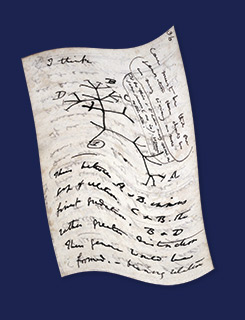
Yet, even Darwin wrote “I think” next to his first evolutionary tree drawing. Why? It’s because he didn’t actually observe evolution. Darwin speculated that life forms could spring from nonliving matter and become increasingly more diverse through random processes. But the transitional fossils that would prove evolution have never been found, and genetics research provides no basis for one creature type transforming into another. Even many evolutionists are beginning to doubt Darwinism.1
The geocentric model eventually died under the weight of new discoveries and the advent of scientists willing to reconsider accepted norms—and evolution is headed in the same direction. The evidence indicates that species don’t evolve; rather, they change because they’re engineered to rapidly adapt themselves to changing environments.2
Just as Copernicus opened the eyes of scientists to the sun’s place in our solar system, ICR works to demonstrate how science truly supports the Genesis account of origins. While evolution is founded on a system of death and chaos, biblical creation represents a model of life and order.
Thanks to your support, ICR is standing against false science and equipping a new generation with God’s creation truth. We’re grateful for your prayers and financial gifts that allow us to carry out research for the glory of God. We invite you to join us in proclaiming Christ Jesus as Creator, Redeemer, and coming King, by whom “all things were created,” both in heaven and on Earth (Colossians 1:16).
References
- Hands, J. Is it time to drop Darwinism? BBC Science Focus. Posted on sciencefocus.com November 22, 2016, accessed March 4, 2024.
- Guliuzza, R. J. 2019. Engineered Adaptability: Continuous Environmental Tracking Wrap-Up. Acts & Facts. 48 (8): 17–19.
* Mr. Stamp is an editor at the Institute for Creation Research.