



The Institute for Creation Research views science through the lens of God’s Word, communicating the many ways that scientific evidence affirms the accuracy and truth of the Bible. ICR’s most recent research initiative is the development of a biological model that examines the innate abilities of living creatures in light of engineering principles.
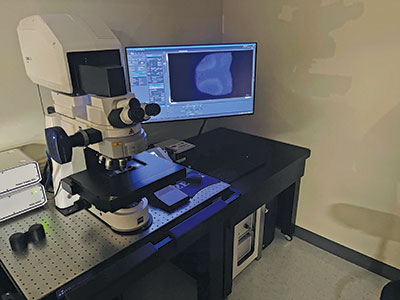
With this new, exciting research paradigm, our staff transformed three areas on our Dallas campus into research venues—a blind cavefish laboratory, a molecular biology laboratory, and a microscopic imaging center. As more funds become available, we plan to expand our current research capabilities, including the acquisition of a combination scanning and transmission electron microscope.
Thanks to several large donations that enabled recent equipment purchases, our scientists are performing controlled experiments on one of the central icons of evolution—the blind cavefish. With no eyes and little skin pigmentation, this fish inhabits underground cave systems throughout the world. Evolutionists erroneously claim that cavefish are the “evolved” descendants of sighted surface-dwelling fish that diverged anywhere from eight million to as recently as 20,000 years ago.
Our laboratory has established reproducing populations of both surface fish and cavefish. Separate environments feature either cyclical high-intensity light to mimic sunlight or very low light combined with low pH levels that are regulated by CO2 gas diffusion into the water. Preliminary results show that cavefish rapidly develop pigmentation when exposed to virtual sunlight and seem to be pre-adjusted to tolerate high CO2 (low pH) water. The opposite is true as the surface fish lose pigmentation across their body when exposed to very low light combined with low pH levels.
These initial results are not surprising for those who realize that from the beginning of time, the Lord Jesus designed fish to be fruitful and “fill the earth” (Genesis 1:21-22). Our research is repeatable, not random, and shows that both of these control groups respond quickly, even within days. The findings contradict Darwin’s theory, which uses natural selection over eons of time as a substitute for the work of our Creator.
If you are an ICR donor, please know that our Lord is working powerfully through your faithful efforts in both your prayers and giving. If you’re new to ICR, please prayerfully consider coming alongside us as a co-laborer and donating to empower ICR’s Christ-centered initiatives. Our goal is to always communicate the scientific evidence that affirms the clarity and truthfulness of God’s written Word. Please visit ICR.org/donate to see our online giving options.
*Dr. Morse is Director of Donor Relations at the Institute for Creation Research and earned his D.Min. from The Master’s Seminary