


The prevailing evolutionist mantra holds that humans and chimpanzees share a common ancestor that lived about six million years ago. One of the most cited evidences for this belief is the alleged human chromosome 2 fusion site. There, evolutionists claim, one can see the degenerate remnants of where two telomeres fused, which they say are leftovers from humans’ evolutionary descent.
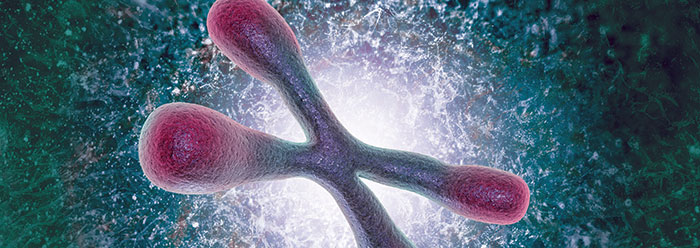
Telomeres are specialized DNA sequences found at the ends of chromosomes in plants and animals. They are uniquely designed to make possible the existence of more-complicated forms of cells that have large linear chromosomes—contrasted with single-cell bacteria that have less-complex circular chromosomes.
Scientists were intrigued when the sequencing of the human genome revealed that sections of telomere sequences also exist throughout the internal regions of chromosomes instead of exclusively at the ends.1 At first, it was believed that interstitial telomere sequences (ITSs) were genetic mistakes and served no useful purpose. The famous head-to-head ITS on human chromosome 2 was initially attributed to an accidental fusion of two ancestral ape-like chromosomes. However, this speculation was disproven. It’s now known this particular ITS is in the middle of a highly expressed gene—functionally acting as a second genetic switch called a promoter.2,3 Telomeres are completely void of genes, so it would be impossible for a telomere fusion to provide the proper DNA sequences to produce a functional gene.
Some scientists also thought that ITSs might actually be dangerous to the genome, and researchers tried to associate them with disease, cancer, and chromosome breakage.1 However, more research showed that these anomalies were primarily associated with other sequences that were physically close to the ITSs and had nothing to do with their presence.1
Amazingly, ITSs show strong evidence of design rather than evolutionary accidents. The presence of ITSs within internal regions of chromosomes affects gene expression by changing the conformational (three-dimensional) properties of the DNA.4 As is typical of the evolutionary mindset, scientists presupposed that ITSs were freak accidents of nature and disruptive to the genome rather than looking for purpose and function. Despite this counterproductive approach, they eventually concluded that ITSs have a distinct function within the genome.
Elsewhere, I showed how the ITS at the alleged human chromosome 2 fusion site was clearly a functional element involved with gene expression.2,3 So, is it possible that other ITS regions across the genome are also important gene-regulating features? As a result of this question, I have written software that has identified ITS regions throughout the human genome and then intersected their genomic locations with a wide variety of publically available data sets from the ENCODE (ENCyclopedia Of Dna Elements) project. The ENCODE project provides a diverse array of functional DNA sequence data across the genome and is ideal for determining the function of a particular DNA sequence. My preliminary data indicate that many ITS regions all over the human genome are directly involved with gene expression, including the binding of specialized genetic switch proteins called transcription factors.
This type of research shows that the gene expression properties discovered for the ITS at the alleged human chromosome 2 fusion site are not unique to that location. Instead of pointing to a common ancestor with chimps, the ITS represents a common functional design feature placed in our genome by an all-wise and omnipotent Creator.
References
- Lin, K. W. and J. Wan. 2008. Endings in the middle: current knowledge of interstitial telomeric sequences. Mutation Research. 658 (1-2): 95-110.
- Tomkins, J. P. 2013. Alleged Human Chromosome 2 “Fusion Site” Encodes an Active DNA Binding Domain Inside a Complex and Highly Expressed Gene—Negating Fusion. Answers Research Journal. 6: 367-375.
- Tomkins, J. P. 2015. More DNA Evidence Against Human Chromosome Fusion. Acts & Facts. 44 (8): 10-12.
- Revaud, D. et al. 2009. Sequence-driven telomeric chromatin structure. Cell Cycle. 8 (7): 1099-1100.
* Dr. Tomkins is Director of Life Sciences at the Institute for Creation Research and earned his Ph.D. in genetics from Clemson University.