


The first chapter of the timeless text of Genesis states, "And the earth brought forth grass, and herb yielding seed after his kind, and the tree yielding fruit, whose seed was in itself, after his kind: and God saw that it was good. And the evening and the morning were the third day."1
In direct contrast, modern consensus insists, "Documented deep in the earth's crust are the progressive changes and modifications undergone by various groups of the plant kingdom through millions of years."2
So, did plants really evolve over eons, or were they created in one day? New research demonstrates exactly why plants had to have been created in an instant.
A team of scientists led by researchers at the Scripps Research Institute and the University of Glasgow investigated the marvelous mechanism by which plant cells detect harmful UV-B radiation and then send signals that activate cellular UV-B protection regimes.3 Without UV detection and prevention, and without all the biochemicals for photosynthesis, plants would have long ago died.
A protein in plants called UVR8 responds to light in just the UV-B range. The protein consists of two identical halves that automatically link to one another just before light hits them. Investigators learned that when UV-B light hits a particular amino acid near the center of the dual complex to change its electrical charges, the halves separate and activate the protein.
The study appears online in Science Express. The lead authors said, "Other light-sensing proteins require a chemical modification or helper molecule to detect light, but UVR8 is unique in that it has these inbuilt UV-B-sensing tryptophan pyramids—structures that no one has seen before."3
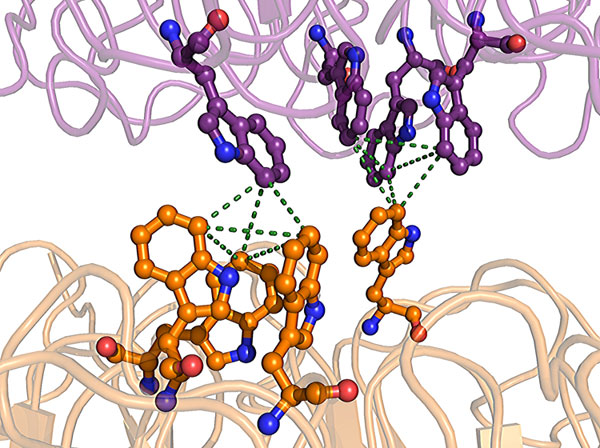
Credit: Getzoff lab, The Scripps Research Institute. Adapted for use in accordance with federal copyright (fair use doctrine) law. Usage by ICR does not imply endorsement of copyright holders.
When separated, each UVR8 protein half somehow quickly signals its cell to activate UV-B protection systems. Human skin cells employ similar tactics to protect against UV light damage, which can cause cancer by disrupting a cell's vital DNA.4
To discover what plant life would be like without the dual-purpose protein UVR8, the researchers mutated UVR8 proteins. "The mutant plants grew poorly when exposed to UV 'B' wavelength radiation—the range most responsible for tanning and burning of human skin," according to a Scripps Research Institute news release.3
If plants evolved over millions of years, then nature would have constructed their UV detection and protection system one piece at a time. But there are too many precisely specified parts for evolution to explain, such as various communicating molecules that detect UV, transport the correct signals to the correct places, receive those signals accurately, and deploy specific responses like activating a gene or producing more or less of a specific protein based on those signals. Building each of these separately and over long periods of time is unrealistic.
This is because it takes more than just UVR8 for all of this to work properly, just as it takes more than just a key for a car to function. In other words, all the parts had to have been put in place all at once. Otherwise, the first imaginary evolving plants would have incurred DNA damage from sunlight faster than the damage could be repaired.
UVR8-like proteins also occur in algae and moss. The evolutionary authors tried to fit these observations into their nature-only paradigm by insisting that UVR8 evolved early and all descendant plants inherited it. But because UVR8 would be useless without many other precisely interacting molecules, inheriting it would have been a waste of energy. UVR8, along with all other vital plant molecules, was created on purpose. The fact that UV damage is detected and repaired by all kinds of plants just means that God designed all plants with foresight.
And that means that the Genesis record had it right all along.
References
- Genesis 1:12-13.
- Delevoryas, T. 1962. Morphology and Evolution of Fossil Plants. In Prothero, D. R. 2004. Bringing Fossils to Life: An Introduction to Paleobiology, 2nd ed. Boston, MA: McGraw-Hill, 435.
- Ultraviolet Protection Molecule in Plants Yields Its Secrets to Scripps Research Team. Scripps Research Institute news release, February 9, 2012, reporting research in Christie, J. M. et al. Plant UVR8 Photoreceptor Senses UV-B by Tryptophan-Mediated Disruption of Cross-Dimer Salt Bridges. Science Express. Published online February 9, 2012.
- Guliuzza, R. 2009. Made in His Image: Melanin, the Sunblock That's Just Skin Deep. Acts & Facts. 38 (8): 10-11.
* Mr. Thomas is Science Writer at the Institute for Creation Research.
Article posted on March 14, 2012.