


Several years ago the skeleton of the largest and most complete Tyrannosaurus Rex was found in South Dakota. Dubbed "Sue," it eventually found its way to the Chicago Field Museum of Natural History. Evolution thinking dates Sue as having lived and died in the Cretaceous period, approximately 67 million years ago.
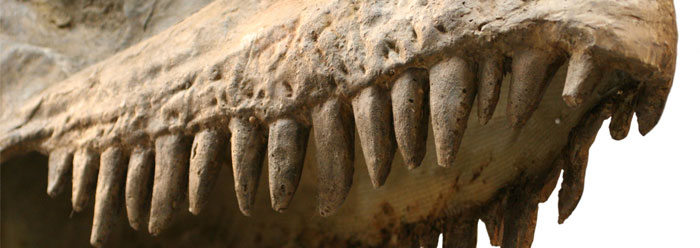
In life, Sue must have cast an imposing figure. She stood some 13 feet high at the hip, and measured 42 feet from head to tail. Her five-foot-long skull contained 58 vicious teeth. Some were curved; others serrated like a steak knife. There were some features, however, which suggest she was as much prey as predator, for Sue bore wicked battle scars. During some past encounter, Sue had broken several ribs. In time they had healed over, leaving visible abnormalities. But a subsequent encounter had broken them a second time.
Sue's skull shows evidence of further misery, for it contained a series of perforations of uncertain origin, due to either an attack or an unknown bone disease or abscess which ate completely through the massive jaw. In either case, Sue's existence must have been wracked with pain and suffering. Further evidence indicates that she had suffered a broken leg many years before death, which confirms the notion that she lived in abject misery. However, "Sue" lived to a ripe old age, perhaps several hundred miserable years.
The rocks surrounding her bones tell us that her body, fairly intact, was buried in sediments deposited by rapidly moving water. Where and how she died we can't tell, but the sediments covered her carcass so completely and deeply that scavengers could not reach it.
Advocates of Theistic Evolution, Progressive Creation, the Gap Theory, and the Framework Hypothesis, all contend that Sue lived and fought and suffered and died in a time long before man. It was a brutal time, replete with carnivorous activity, disease and extinction. In this scenario, it was the extinction of the dinosaurs which gave rise to the mammals, and finally man. In other words, God used death to produce man, and at the end of it all, God pronounced it all "very good" (Genesis 1:31).
But according to a straight-forward reading of Scripture there was no death in the beginning, no carnivorous activity, no burial, no fossilization. God had created conscious life to live forever under the wise dominion of His image re-created in man. There was no pain, no suffering. No animal attacks, no infectious diseases, no broken bones. These entered creation after Adam rejected God's authority over him—he sinned against God, and thus incurred the "wages of sin" for his actions. From then on Adam, his descendants, and all in his dominion, suffered under the penalty and presence of sin in a world no longer "very good."
So that's the question. Did Sue live and kill and suffer and die in a world deemed "very good" by the gracious, loving God of Scripture? Or, did these gruesome aspects and activities follow the ruination of the "very good" creation by Adam's sin and the resultant curse?
Which type of world could God call "very good"? All Christian advocates of an old earth must hold that Sue, her time, and condition predated Adam, and thus was deemed "very good" by God.
Surely some things just can't be.