


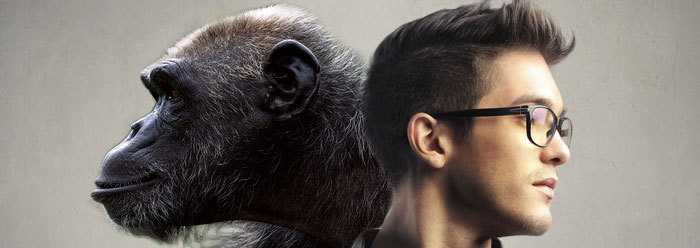
Frequently we see the statement that man is an advanced animal, implying he is higher on the evolutionary tree than the others. Let's examine this claim.
Remember that evolution holds that simple forms of life spontaneously arose from non-life. Through mutation and natural selection they increased in complexity to multi-cellular animals to invertebrates to vertebrate fish. Next, some evolved into amphibians, then reptiles, then birds, and mammals. The standard view of evolution considers each stage more "advanced," or more complex than its predecessors until finally man arrives. In reality, however, all animals, living or fossil, are unthinkably complex. Each shows interdependence of functioning parts, each with a marvelous purpose to achieve. Even a single cell is more complex than a super computer. There is no such thing as simple life. If it's alive—it's complex.
Consider the "lowly" insect—pick one. As you study it, you'll discover an undreamed of complexity. Or the extinct arthropod, the trilobite sporting a powerful eye with a complex lens, equally as advanced as any today.
Or consider various mammals—from the whale with an intricate language, to the appreciation of beauty among some birds, to the use of "tools" among some primates—animals exhibit amazing abilities.
Similar traits or organs or abilities are also found in man, although our sight is not as good as the hawk's, our hearing is not as good as a dog's, etc. Each has its own nitch to fill.
Yet man is different. His "higher" characteristics have more to do with his
intelligence, his ability to plan and consider the future, and ability to express emotions. Animal instincts and habits are remarkable, but something sets man apart.
We find this difference explained in the record provided by the Creator of man and the animals. In Genesis One we see that the fish, the birds, the creeping things, the cattle, the beasts of the field, and the beasts of the earth were all created "after their kinds." But when God created man, He created him "after His own image." We often have similar DNA to the animals, similar body parts, similar functions, similar consciousness, similar blood, but the comparison disappears when man's eternal spirit is considered. The animals have nothing like this. Something about man adequately reflects God's nature in a way that the animals don't share.
God created man with the wonderful ability to reason and comprehend abstract thoughts. He alone can speak in a language which communicates his inner yearnings. Most importantly, man can truly love and respond to love, most particularly the love of God. He can recognize his own sinfulness, repent of it, and appreciate God's gracious solution to his sin problem. He can respond to God's love by choosing a life pleasing to Him. Animals, regardless of their cranial capacity, know nothing of this.
Man is qualitatively superior to the animals in many important ways. But he is also quantitatively distinct from all animals.
No, man is not a higher animal. Man is not an animal at all. He is the very image of God, and nothing less.