


The more we study about the great Flood of Noah's Day, the more we realize it was a time of vast tectonic change on earth. Scripture provides the basic framework for all knowledge, but doesn't necessarily give every detail, leaving it up to the Christian to "think God's thoughts after Him." Processes during the great Flood acted on an unimaginable scale, accomplishing extensive geologic work.
The Flood-Activated Sedimentation and Tectonics (FAST) project at ICR researches this great cataclysm, adding to our understanding of Scripture. One such study within FAST, funded by ICR's National Creation Science Foundation (NCSF), shows particular promise. Its title indicates its expected conclusions: "Reinterpretation of Thrust Faulted Terrains as Gravity-Driven, Catastrophic Superfaults."
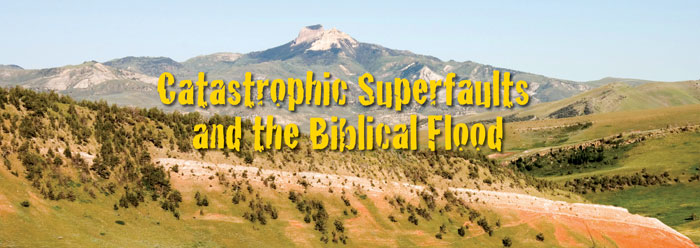
This project involves one of the most studied and least understood phenomena in the world--overthrusting. Heart Mountain's strata are known to be "out of order," with the "older" layers stratigraphically above the "younger" ones. Earlier creation scientists considered this to be merely a depositional anomaly that disproved the geologic column, but consistent investigation has demonstrated the "reversed" order. Most scientists, both creationists and evolutionists, conclude that large blocks were moved extraordinarily rapidly, requiring abnormal pore pressures building up in a saturated condition to buoy the rock along at such a rapid pace.
But how did this happen? Observations that the thick rock sequence was moved horizontally from its place of origin explained the data, but no theory existed as to how this could have been achieved. Certainly catastrophism was involved, but how did it accomplish the job? The new FAST study seeks to explain this. Excerpts from its abstract follow.
The Heart Mountain Fault and the nearby South Fork Fault (SFF) in northwest Wyoming are two of the most widely known structural enigmas in North America. The mystery of the origin and emplacement mechanism of these two faults remains unsolved after over 100 years of study.
The biggest dilemma has been the mechanical difficulty of moving 50 large carbonate blocks a distance of over 30 miles (50 km) along a slope of less than two degrees. Several authors have demonstrated quite conclusively that simple gravity sliding could not generate the pore pressures necessary to move coherent rocks down such a flat incline. More recent authors have failed to resolve this problem, other than to suggest a catastrophic genesis can somehow invalidate the pore pressure problem.
Phase 1 of this proposal aims to address the problem of large rock movements within the framework of the biblical Flood event, interpreting both faults as superfaults. Phase two involves the numerical modeling by Dr. John Baumgardner of the SFF. Phase 3 will complete the necessary field work on the SFF in 2009. Phases 4 and 5 will begin the extension of this research to other overthrusted terrains in the Rocky Mountains and to understand underthrusted subduction zones, searching for other superfaults.
We anticipate this project will add much to our understanding of Flood processes. It has the potential of turning a plaguing problem for creationists into a strength, providing the only adequate mechanism, and removing another stumbling block to salvation. As always, interpreting geology in light of revealed Truth will enlighten our thinking and witness.
NCSF has become the research arm of ICR and solicits designated funding to support investigations like this one, thereby equipping the Christian scholar and confronting the skeptic. Proposals for funding are welcome and can be sent directly to ICR. Gifts to help fund this research are also welcome.
* Dr. Morris is President and Director of Research at the Institute for Creation Research.
Cite this article: Morris, J. D. 2009. Catastrophic Superfaults and the Biblical Flood. Acts & Facts. 38 (4): 23.