



“And God blessed Noah and his sons, and said unto them, Be fruitful, and multiply, and replenish the earth” (Genesis 9:1).
This was the first command given by God to mankind in the new world after the Flood. Actually, it simply renewed the first command given to Adam and Eve in the primeval world. “And God blessed them, and God said unto them, Be fruitful, and multiply, and replenish the earth . . .” (Genesis 1:28). The Old English word “replenish” means simply “fill,” and the same is true of the Hebrew word (mala), from which it is translated. In fact, of its 220 occurrences, the King James translators rendered it “replenish” only seven times. Almost always, they translated it by “fill,” or the equivalent.
Thus, God’s first command to men and women was to multiply until the earth was filled. Despite our latter-day concerns about exploding populations, this goal is far from accomplishment today. “Filling,” of course, would imply filling only to the optimum capacity for productive human stewardship of the earth under God.
The pre-Flood earth was filled in only 1656 years, but it was “filled with violence through them,” and God finally had to “destroy them with the earth” (Genesis 6:13)
In spite of man’s failures, the Lord has given a gracious promise: “And the LORD said, . . . as truly as I live, all the earth shall be filled with the glory of the LORD” (Numbers 14:20,21). This will not be man’s doing, however. When Christ returns in power and great glory as the destroying Stone, then “the stone that smote the image became a great mountain, and filled the whole earth” (Daniel 2:35). The New Earth will finally be filled with an innumerable multitude of the redeemed (Revelation 7:9), and “the earth shall be filled with the knowledge of the glory of the LORD, as the waters cover the sea” (Habakkuk 2:14). HMM

Filling The Earth
More Days of Praise

Prayer for All Men
“I exhort therefore, that, first of all, supplications, prayers, intercessions, and giving of thanks, be made for all men.” (1 Timothy...
Resisting the Devil
“Be sober, be vigilant; because your adversary the devil, as a roaring lion, walketh about, seeking whom he may devour: Whom resist steadfast...
Magnified Mercy
“Behold now, thy servant hath found grace in thy sight, and thou hast magnified thy mercy, which thou hast shewed unto me in saving my life;...
The Latest
Watching PBS: Don’t Think Too Hard About the Brain’s Origin!
This past summer, the British Broadcasting Corporation (BBC) addressed the subject of origins in the five-part television series Evolution.1...
The Engineering Behind Every Heartbeat
The human heart does not beat like a perfect clock. The time between beats changes as the body breathes, moves, rests, and reacts to the world around...
Blood Vessels: Built to Sense and Respond to Force
Blood vessels do more than carry blood. As tissue grows or heals, new vessels must form in the right place and direction, through a process called angiogenesis....
Hummingbird Hawkmoth Exhibits Astonishing Abilities
The incredible hummingbird hawkmoth (Macroglossum stellatarum), and other insects of the Lepidoptera order, continue to amaze entomologists.1,2...
More Than Just Parts: The Networking of Cells
An engineer can list every part in a system and still miss how it works. Think of a radio. Its parts matter, but so does the wiring that joins them....
Living Centenarian Sturgeon: Extreme Genesis Longevity Is Plausible
Native American oral tradition contains stories of sturgeon living for centuries. While this was largely seen as folklore among conventional scientists,...
Brainy Bees Solve Pollen Problem
The uncanny abilities of the honeybee cause entomologists to shake their heads in wonder.1,2
Scientists have long known that honeybees...
October Wallpaper
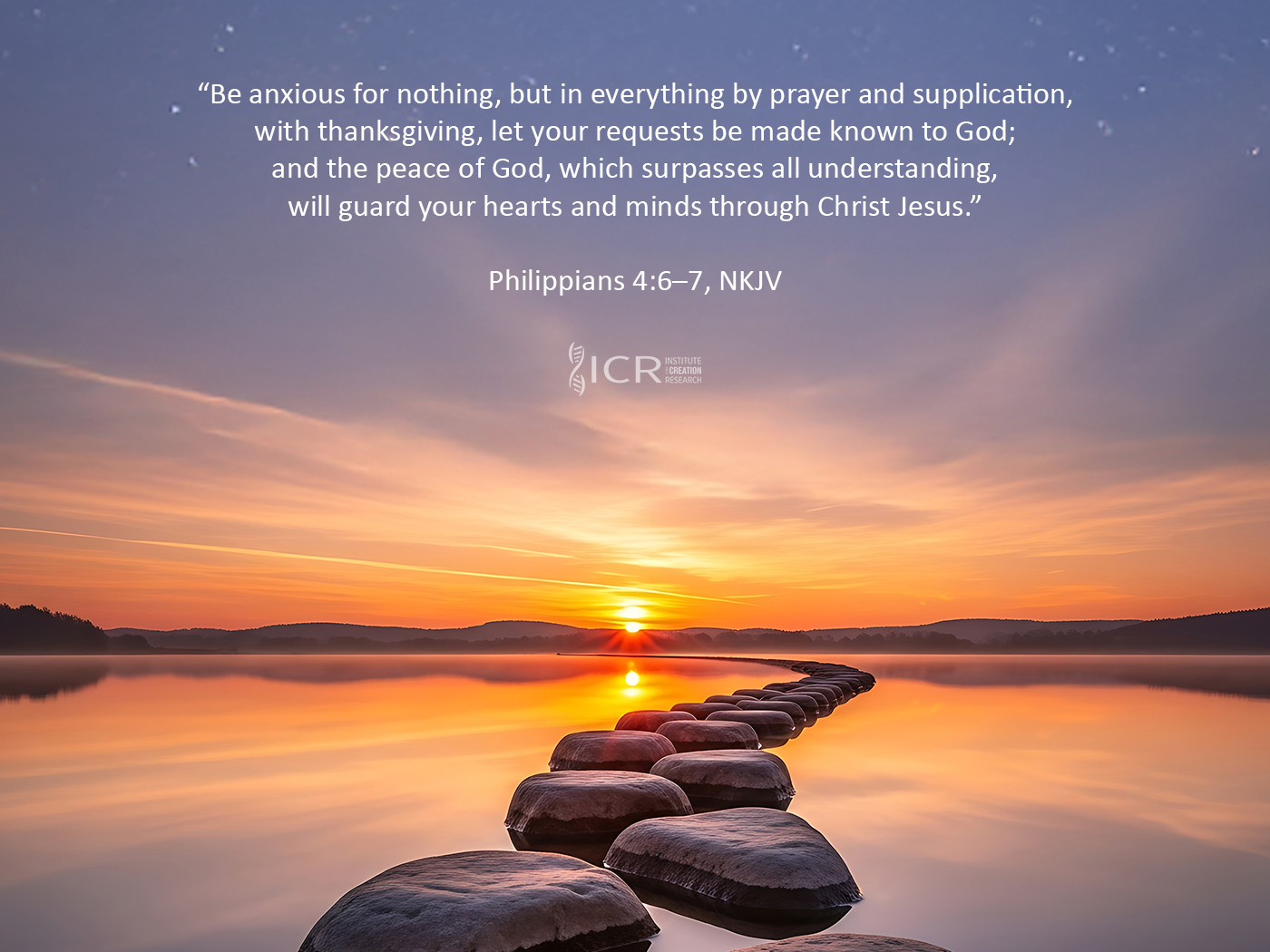
"Be anxious for nothing, but in everything by prayer and supplication, with thanksgiving, let your requests be made known to God; and the peace...
Possible Ark Site Has Mainstream Media Hopping
An organization named Noah’s Ark Scans is investigating a site called Durupinar, almost 20 miles from Mount Ararat in Turkey. Could it contain...
ANNOUNCEMENTS
Heroes of Creation Science: Henry M. Morris
“The creation/evolution issue is, in a very real sense, the most fundamental issue of all.” —Henry M. Morris
Many people believe the...
Shop Related Products

The Beginning of the World
$10.99

A Year of Praise
$14.99