


On December 3, 1996, the announcement was made in newspapers around the world. Spacecraft observations of the moon had led investigators to conclude that a small lake of ice was present near the moon's South Pole, in an area never reached by the sun's light and warmth.
The newspaper followed a technical article in Science, 29 November 1996, pp. 1495-1498, and preceded a news conference hosted by NASA and the Pentagon, co-sponsors of the project. As usual, the technical information reflects careful science, complete with qualifiers of other possible alternatives, while the popular account contains overstatements and poorly-thought-out speculations. First we need to separate out the facts.
A radar signal, bouncing back from the lunar surface, exhibited a unique polarization over a small area. It came from the bottom of a deep crater near the moon's polar region, an area in permanent shadow. Scientists felt that the best interpretation of this data was that it was a "lake" of ice, likely frozen water, but perhaps some other material, so cold that it would never melt nor sublimate.
The lake was, at most, only a few kilometers on each side, not particularly deep, and was probably permeated or covered with lunar soil. It is in a most inaccessible region, not easily studied by any means, but certain to attract more attention. We await further investigation for positive identification.
Caution must be exercised before speculating about using this water to grow crops and supplement an atmosphere for a moon colony as some are doing.
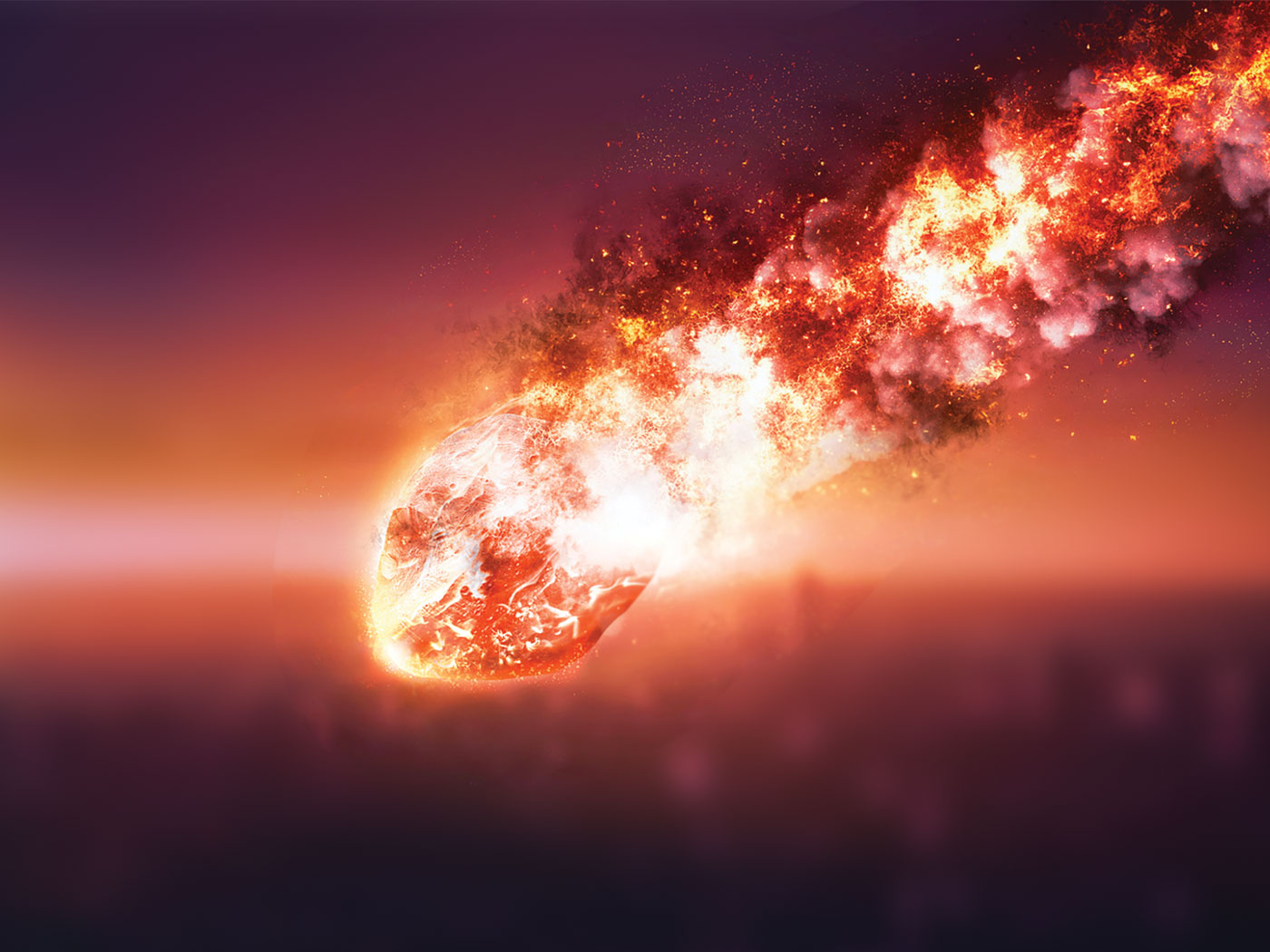
The big question is, if this is water, what is its origin? Creationists are just as interested in this as evolutionists. My evolutionary colleagues are couching their speculations in the idea that the solar system coalesced from interstellar dust some five billion years ago. They wonder if some icy comet collided with this dark portion of the moon, depositing the permanently frozen ice.
Creationists would also look to a commentary source as a possibility. The moon has been pelted with major impacts in the past, as have Venus and Mars. We now recognize many "astro-blemes" on Earth's surface. These latter must date to the time after the Flood, since any impacts before the Flood would have been obliterated, and any during the Flood would not have been recorded.
Obviously, we cannot know by scientific observation, but it is theologically tempting to suggest that the craters on the moon were not present at the "very good" creation, but date from after the curse of Genesis 3.
It may be that part of the horror of the Flood included bombardment from space, affecting not only Earth but its neighbors as well. Certainly some parts of space are "dirtier" than others, and Scripture prophecies a similar coming bombardment. There is much to learn about the history (and future) of God's creation, and it may be that this new information may help discern it.
And that's the point. We should welcome each new observation of the way things are and the way they operate. Not always will speculations about history or origins be helpful, but the more we learn, the more we recognize that "the heavens declare the glory of God" (Psalm 19:1).
The vastness of creation, and the variety of its character speaks of the creator's omniscience and omnipotence. I for one look forward to an eternity of time in which to explore God's infinite Creation, to His glory. And then we may just get that colony on the moon.
* Dr. John Morris is President of ICR.
Cite this article: Morris, J. 1997. Is There Water on the Moon? Acts & Facts. 26 (1).