



A new high-speed, 40-processor research computer was delivered to ICR in August and within days began crunching numbers to support new research. ICR is expanding its efforts in numerical simulation and plans to use this computer to perform model development and data analysis in several new areas.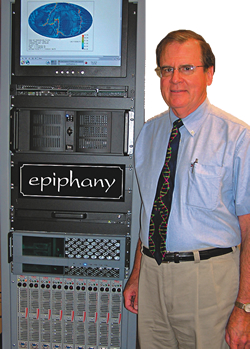
The computer was custom designed and fabricated by Davis Systems Engineering of Princeton, New Jersey, in collaboration with Dr. John Baumgardner, the new head of ICR's research computing center. It consists of 40 AMD 64-bit Opteron 2 GHz processors, each with 1GB of memory. The unit has the speed of 120 older processors used previously by Dr. Baumgardner in a similar configuration. The multiple processors are connected via gigabit Ethernet through a 24-port crossbar switch. Message Passing Interface (MPI) software allows individual applications to run simultaneously on multiple processors.
The new computer has been named Epiphany, which means to reveal or show forth, particularly to commemorate Jesus as the Christ. Dr. Baumgardner hopes the work on this new resource will lead to breakthroughs in creationist understanding in many fields.
Problems Dr. Baumgardner intends to explore include catastrophic sedimentary processes, regional and global tectonic processes, paleoclimatic/Ice Age studies, early cosmos dynamics with non-Copernican boundary conditions, galaxy dynamics and development, effects of mutation and selection of genomic stability, and detailed human/chimpanzee genome comparison.
Dr. John Baumgardner has more than 30 years of professional experience in large-scale numerical modeling, including 20 years in a computational fluid dynamics group at Los Alamos National Laboratory. Several other researchers who intend to use the computer also have considerable numerical modeling experience. Some of the researchers who plan to use the computer immediately on high-priority projects include Drs. Larry Vardiman, D. Russell Humphreys, Steve Austin, Andrew Snelling, and Dan Criswell.
The new computer was paid for by gifts from a generous donor to ICR research last January. However, support for the individual research projects is still needed. If you are interested in donating to the Epiphany project or specifically to any of the associated research projects, please contact Dr. Larry Vardiman at 619/448-0900 or LVardiman@icr.edu. Anticipated computational research topics include modeling of submarine debris flows, submarine cross-bed formation, runaway subduction, rapid mountain uplift, Ice Age climate dynamics, cosmologies without the assumption of the Copernican principle, galactic spiral structure development, limits and costs of natural selection, effects of environmental "noise" on genetic selectibility, effects of near-neutral mutations on long-term genomic stability, genome comparison between human and chimpanzee, as well as many yet to be identified areas of origins research.
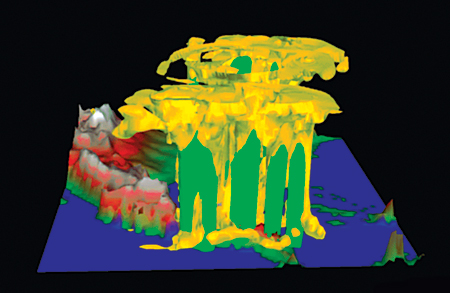
Example of computer modeling done by Dr. Larry Vardiman.