



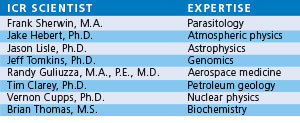
If ICR scientists are “real” scientists, then they should publish in respected, peer-reviewed, mainstream journals, right? In fact, many have.1 But mainstream journal editors’ zeal for naturalism can keep them from fairly analyzing contrasting views on origins—leading them to say “no” to quality creation science.
Science reviewers and journal editors serve as gatekeepers, closing the gate to prevent bad science from reaching the printed page. For example, they are right to reject a submitted article if its conclusions rest more on speculation than on results.2 But they can also close the gate for unscientific reasons.
Mainstream gatekeepers generally maintain a bias against God, His work, and His Word. They therefore can close the publication gate to science that confirms Scripture, regardless of the quality of that science. The problem peaks in historical disciplines where naturalist gatekeepers axe all challenges to their tightly held belief in billions of years of evolution.
Take geology, for example. Geologists fit observable rock features into an unobservable rock history. Naturalist geologists strongly favor rock histories that include millions of years, even if they must disregard evidence for recent rock origins.3 Gatekeepers exercise their anti-Bible bias when they reject manuscripts that challenge uniformitarianism—the belief that the rates and intensities of present processes like erosion, river flows, and seismic activity explain all of geology.
I once spoke with a creation geologist who submitted a paper about billions of straight-shelled nautiloid fossils entombed in a single limestone layer that spans several southwestern U.S. states. The mainstream editor replied that he rejected the paper because it implies that a no-longer-present process best explains this titanic rock layer. It seems he was uncomfortable with the idea that only a flood with enough force to affect the whole globe could leave that many sea creatures stranded on a continent beneath that much lime mud.
 Another rejected manuscript included photos taken through a microscope of sharply angled sand grains. These convincingly reveal that deep and fast-moving water, not wind, deposited the Grand Canyon’s Coconino Sandstone.4 Wind abrasion should have rounded its sand grains. The Coconino also contains animal footprints, which only wet sand can preserve. But no mainstream journal was willing to print evidence that contradicts their dogma that a present process like desert wind formed this ancient sandstone.
The mainstream journal PLOS ONE published a paper describing the precise coordination between nerves, muscles, and finger motions in the human hand. Its Chinese authors wrote that this anatomy reflects “proper design by the Creator.”5 The evolutionary community revolted and forced the journal to retract the paper,6 which is available online.
Mainstream journals will sometimes publish a creation scientist’s results that deal more with straightforward observations than origins, like modeling the sun’s effect on global temperature or crafting algorithms to improve pacemakers. But these God-fearing authors generally keep a low profile. If they draw too much attention to the fact that they believe the Bible, then those gates could close. And creation scientists who take their salaries from naturalist-dominated institutions cannot obtain research grants unless they publish results.
Creation research would appear in mainstream journals if naturalist gatekeepers stuck strictly with data and logic. Instead, they also judge work based on evolutionary doctrines like millions of years and an infinite potential for creatures to change from one type to another. For this reason, ICR funds scientific research into origins questions that naturalists wouldn’t dare ask.7
References
- Access some of the ICR scientists’ peer-reviewed technical articles at ICR.org/events/speakers
- Other legitimate reasons to reject a submission include too few results, a lack of adequate experimental control, or other problems like internal contradictions.
- Find this evidence at ICR.org/recent-creation.
- For more on this subject, see Morris, J. 2010. The Coconino Sandstone: A Flood or a Desert? Acts & Facts. 39 (7): 15.
- Liu, M. J. et al. 2016. Biomechanical Characteristics of Hand Coordination in Grasping Activities of Daily Living. PLOS ONE. 11 (1): e0146193.
- Cressey, D. Paper that says human hand was ‘designed by Creator’ sparks concern. Nature. Posted on nature.com March 3, 2016, accessed July 12, 2016.
- Three main creation-based technical journals provide peer-reviewed outlets for ICR and other creation scientists. In order of longevity, these are the Creation Research Society Quarterly, Journal of Creation, and Answers Research Journal.
​* Mr. Thomas is Science Writer at the Institute for Creation Research.