


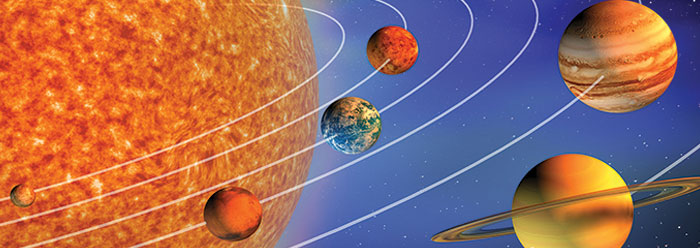
For decades it has been somewhat of a mystery to secularists as to why our solar system is structured the way it is: the four gas giants—Saturn and Jupiter, composed mainly of helium and hydrogen, and Uranus and Neptune—orbiting far away from the sun, and the four smaller rocky planets, the terrestrials—Mercury, Venus, Earth, and Mars—orbiting much closer to the sun.
Astronomers are puzzled that other recently discovered planetary systems look so different from ours. One evolutionist stated, “There are so many surprises in this field—almost nothing is turning out as we expected.”1 Indeed, for the secular astronomer, basic planet construction is caught on the horns of a dilemma.
The predicament is this: Planet formation must occur quickly before the protoplanet is pulled into the star it’s orbiting, but getting tiny bits of protoplanet dust to join up into nice, round spheres and thence into a proper planet has not been found to work. Many stars in our Milky Way possess spinning disks of matter—orbiting gas and dust—but there are three significant problems in forming planets from these ingredients: death spirals, accretion (the gradual growth of planets by the accumulation of debris), and turbulence.2 The building of planets large and small is an enigma, and “many aspects of the formation of the giant planets remain unresolved.”3 An evolutionist writing in the prestigious Nature journal stated,
The discovery of thousands of star systems wildly different from our own has demolished ideas about how planets form. Astronomers are searching for a whole new theory.4
But even if our neighboring planets somehow formed quickly from accumulating space dust, recently discovered exoplanets (extrasolar planets) have changed secular solar system formation theory.5 Ours is certainly unique: “Today we know that planetary systems are quite common, but in many cases the ones we see differ significantly from our own.”6 Finkbeiner concurs, stating, “Perhaps the biggest question is why our Solar System is so different.”7
Exceptional star systems require, well, an exceptional star:
There are many factors that would make a star system too hostile for life to even get started, let alone survive for any period long enough to evolve. So what sort of star provides the perfect conditions for a habitable planet elsewhere in the universe?8
It so happens our sun provides the perfect conditions. It’s not too small (i.e., too dim or too cool) or too big (producing unfortunate charbroiled results from simply being too hot). Compared to the intense and violent activity seen on other stars, our sun is remarkably even-tempered and well-mannered—it doesn’t flare or pulse like other stars. When solar flares do occur, they are not so violent as to vaporize our oceans…or worse.
On the local level, our moon is equally amazing, leading two secular authors to ask, “Who built the Moon?” Knight and Butler state, “The Moon is 400 times smaller than the star at the centre of our solar system, yet it is also just 1/400th of the distance between the Earth and the Sun.” Consequently, the moon and sun appear exactly the same size in Earth’s sky—making precise solar eclipses possible. The authors also say, “By some absolutely incomprehensible quirk of nature, the Moon also manages to precisely imitate the perceived annual movements of the Sun each month.”9
Another secular author expressed surprise at the moon’s amazing orbit:
The Moon’s orbit is fiendishly difficult to explain, moving as it does around a rotating Earth, which together form [essentially] a ‘double-planet’ system that orbits around the Sun. It is a classic example of a three-dimensional, gravitational three-body problem.10
After seeing the precise placement of our planets with their right distances, masses, gravitational attractions, and orbital characteristics, is it any wonder one evolutionist said,
You might also think that these disparate bodies are scattered across the solar system without rhyme or reason. But move any piece of the solar system today, or try to add anything more, and the whole construction would be thrown fatally out of kilter. So how exactly did this delicate architecture come to be?11
Move any piece and it throws the whole solar system fatally out of kilter? Sounds like it must have been set up in a delicate balance—a precisely orchestrated cosmic dance, if you will—from the very beginning. A French astrophysicist confirms the remarkable precision of our outer planets’ relationship to Earth:
Jacques Laskar discovered that the orbits of Jupiter and Saturn keep the earth’s orbit from becoming chaotic. Without the orbital stability produced by Jupiter and Saturn, the earth’s orbit would make extreme changes, causing instability in our climate and making the earth uninhabitable.12
To conclude, our solar system is so unique that Mike Brown, a secular astronomer at Caltech, bemoaned, “It really is something that I find deeply weird....What does it all mean? I don’t know.”13
“Almost nothing is turning out as we expected,” “astronomers are searching for a whole new theory,” “by some absolutely incomprehensible quirk of nature,” “fiendishly difficult to explain,” “fatally out of kilter,” “deeply weird”—these comments don’t seem very scientific. They reflect the desperation of the secular scientists’ worldview.
The satisfying answer to the question of our solar system’s origin is found in the opening pages of Genesis. Our solar system was designed complete, intact, and perfectly balanced by the Creator, for the full benefit of us His creatures, during the creation week just thousands of years ago.
References
- Woo, M. Y. 2010. Discovering New Worlds. Engineering & Science. 73 (3): 18-23.
- Asphaug, E. 2009. Growth and Evolution of Asteroids. Annual Review of Earth and Planetary Sciences. 37: 413-48.
- Chaisson, E. and S. McMillan. 2014. Astronomy Today. Boston: Pearson Publishers, 154.
- Finkbeiner, A. 2014. Astronomy: Planets in chaos. Nature. 511 (7507): 22-24.
- Chambers, J. E. 2009. Planetary Migration: What Does It Mean for Planet Formation? Annual Review of Earth and Planetary Sciences. 37: 321-344.
- Chaisson and McMillan, Astronomy Today, 379.
- Finkbeiner, Astronomy: Planets in chaos.
- Nicholson, B., B. Carter, and J. Horner. For life to form on a planet it needs to orbit the right kind of star. The Conversation. Posted on theconversation.com December 1, 2014, accessed September 21, 2015.
- Knight, C. and A. Butler. 2005. Who Built the Moon? London: Watkins Publishing, 4-5.
- Dumé, B. Moon’s bulge linked to early orbit. PhysicsWeb. Posted on physicsworld.com August 3, 2006, accessed September 21, 2015.
- Webb, R. 2009. Unknown solar system 1: How was the solar system built? New Scientist. 2693: 31.
- Bickel, B. and S. Jantz. 2001. Creation & Evolution 101: A Guide to Science and the Bible in Plain Language. Eugene, OR: Harvest House Publishers.
- Krulwich, R. Our Very Normal Solar System Isn’t Normal Anymore. National Public Radio. Posted on npr.org May 7, 2013, accessed September 1, 2015.
* Mr. Sherwin is Research Associate, Senior Lecturer, and Science Writer at the Institute for Creation Research.