


A new discovery may shed light on how the great Flood began. In a paper published in Nature Geoscience, German scientists found evidence suggesting the earth’s mantle was up to 300 degrees Fahrenheit hotter during the initial, formative stages of the Atlantic Ocean—when the continents began to violently pull apart to create it—compared to today.1 Over time, the mantle cooled to current levels.
The scientists studied the composition of oceanic crust using deep-sea drilling core samples and found a systematic change in chemistry from the shoreline—the edge of the continents—to that of the middle of the ocean. The shifts in the core sample’s geologic chemistry were linked to changes in the temperature of the underlying mantle that generated the oceanic crust.
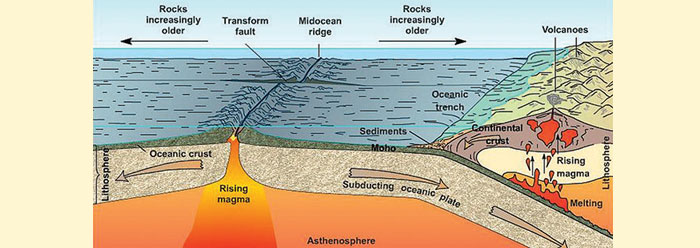
These findings suggest that the initiation of the great Flood began with an anomalously high-temperature mantle beneath the pre-Flood continents. As the continents rifted apart, new ocean crust formed rapidly between them, and molten mantle filled the ever-widening gap, supporting the concept of catastrophic plate tectonics as postulated by creation scientists.2
Today, new ocean crust forms along ocean ridges where continental plates continue to slowly pull apart. The ridges, a system of subsea mountains that run through every ocean, are ridges rather than valleys because the spreading seafloor is hot and constantly rises due to its lower density. The ridge system extends for over 37,000 miles and accounts for about 75 percent of the present volcanic activity on Earth.1
The German scientists also noted that the average ocean ridge today resides at a depth of 1.8 miles below sea level. In contrast, they calculated that the ridges above the hotter mantle in the past would have only been about 0.6 miles below sea level—well over a mile higher!1
What effect would this have had? Shallower ridges from higher heat flow would have raised global sea levels, at least partially accounting for the inundation of the continents during the Flood event. Later, as the mantle progressively cooled, as confirmed by this paper, the ocean ridges would have sunk, dramatically dropping sea level and draining the water off the continents to end the Flood.
In a related article summarizing the recent findings, it was pointed out that “much of the ancient oceanic crust seems to have been generated under conditions that are rare beneath present-day ridges.”3
Rare indeed. The global Flood was a one-time unimaginable event, never to be repeated (Genesis 9:15). The high-mantle heat that apparently initiated the breakup of the pre-Flood continents only occurred once in the past. This heat flow also raised the seafloor ridges and helped flood the land masses. The subsequent cooling of the mantle dropped the ridges and provided a way for the water to drain off the land and back to the deepening ocean basins. Present-day volcanic activity at the ocean ridges is minute compared to the catastrophic formation of oceanic crust during the year-long Flood. It’s amazing how science again and again confirms biblical truth.
References
- Brandl, P. A., et al. 2013. High mantle temperatures following rifting caused by continental insulation. Nature Geoscience. 6 (5): 391-394.
- Austin, S. A., et al. 1994. Catastrophic Plate Tectonics: A Global Flood Model of Earth History. In Proceedings of the Third International Conference on Creationism. R. E. Walsh, ed., Pittsburg, PA. Creation Science Fellowship, Inc., p. 609-621.
- Langmuir, C. 2013. Older and hotter. Nature Geoscience. 6 (5): 332-333.
* Dr. Clarey is a Research Associate at the Institute for Creation Research and received his Ph.D. from the University of Western Michigan.
Cite this article: Clarey, T. 2013. Hot Mantle Initiated Ocean and Flood Beginnings. Acts & Facts. 42 (8): 15.