


The question of the historicity and the character of the Genesis Flood is no mere academic issue of interest to a small handful of scientists and theologians. If a worldwide flood actually destroyed the entire antediluvian human population, as well as all land animals, except those preserved in a special Ark constructed by Noah (as a plain reading of the Biblical record would lead one to believe), then its historical and scientific implications are tremendous.1
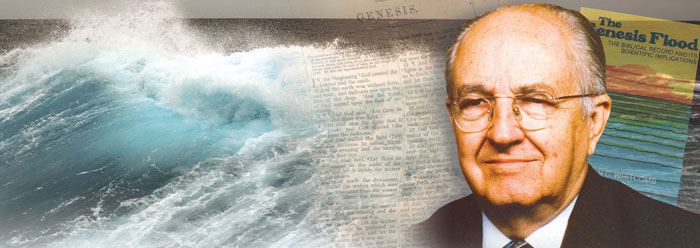
Barely a century after the publication of Darwin’s famous book On the Origin of Species, Dr. Henry Morris and Dr. John Whitcomb wrote those words in the Introduction of The Genesis Flood.
Christian scholarship had largely retreated from the biblical message during that century—first by the theological liberals who adapted the scientific establishment’s capitulation to natural selection and naturalistic evolution by embracing the idea that God used evolution to create. Then came various attempts to allegorize the words of Genesis with “day-age” systems that lumped the stages of evolutionary development into sequential ages that God (it was assumed) adapted to the cultural ignorance of Moses’ day.
Darwin was not the first to embrace evolution by any stretch of the imagination. He was preceded by Lamarck and Charles Lyell and by the growing popularity of “naturalists” among the social elite of Europe. Prior to those relatively recent thinkers, there were literally millennia of pantheistic and polytheistic philosophers and religionists espousing mythology of every stripe and description. Atheistic evolution in one form or another has been recorded in history from ancient Babylonian days. It is not new. It had merely become “scientific” during the “enlightenment” of the Industrial Revolution.
Strangely enough, it was the scientists of those days who most vehemently opposed naturalistic thinking. Johann Kepler and Francis Bacon in the 1600s and Isaac Newton and Carolus Linnaeus in the 1700s all vigorously resisted the growing tendency to write God out of the design, order, and purpose in creation.
By the time of the Scopes trial in 1925, Christian scholarship had either embraced some form of theistic or day-age evolution, or had consigned the ages of evolution to a “gap” between the first two verses of Genesis 1. Creation was relegated to a “secondary doctrine”—not even included in the famous “Five Fundamentals of the Faith.”2 Science had become the purview of evolutionists, and Christianity essentially retreated from the scientific arena and capitulated to the intellectual pressure of academic secularism.
Dr. Henry Morris’ early books began chipping away at the strongholds of evolution with the publication of That You Might Believe in 19463 and The Bible and Modern Science in 1951,4 initially raising a storm of negative reaction from the “intellectuals” in the American Scientific Affiliation (ASA)—especially after a release of adapted articles in InterVarsity’s His magazine. Bernard Ramm published his negative critique of recent creation in his 1954 release A Christian View of Science and Scripture,5 effectively winning over the growing intellectual prowess of the “neo” evangelicals. Very few technically educated Christians seemed to be willing to accept the Bible at face value.
During the decade of the 1950s, Drs. Morris and Whitcomb met and began to collaborate on what would become the 1961 release of The Genesis Flood. That book, in the sovereign plan of God, became the catalyst that opened the gates to the pent-up flood of Christian professionals who, like God’s loyal “seven thousand” in the days of Elijah,6 had not yet bowed their knee to the Baal of evolutionary compromise. A revival among scientifically trained Christians had begun.
The Creation Research Society (formed in 1963) was established for Christian professionals with at least an M.S. degree in one of the sciences who openly espoused a recent creation of all things in six 24-hour days. This society grew rapidly, now with a worldwide membership reaching thousands of professionals and with the CRS Quarterly—a technical journal for peer-reviewed scientific studies in creation science.
Christian Heritage College (now San Diego Christian College) was formed in 1970 with Dr. Tim LaHaye as its President and Dr. Henry Morris as its Academic Vice President. Dr. Morris had agreed to leave his tenured position as Chairman of the Civil Engineering Department at Virginia Polytechnic Institute (Virginia Tech, as it is now known) to help found this fledgling school and to give birth to what is now the Institute for Creation Research (ICR).
ICR’s faculty grew as Christian Heritage College grew, eventually starting its own graduate school with four degree programs in the sciences. Graduates from both those schools became teachers and pastors across the nation, many of whom would later start full-time creation ministries of their own. Where one small effort began as the passion of a dedicated educator, there are now hundreds of organizations teaching a recent creation to literally hundreds of thousands of Christians around the world. For example, Ken Ham of Answers in Genesis began his American ministry under ICR’s sponsorship and now has reached over one million visitors with the Creation Museum in Petersburg, Kentucky.
It is no stretch to say that over a million people each year read or hear accurate, scientific, and solidly biblical information about a young earth and a global flood from the various publications and media ministries of all these creation organizations.
Dr. Morris went on to write some 60 books during his 36-year ministry with ICR, many of which are still in print. The Genesis Flood now celebrates its 50th year in continuous publication! Hundreds of Days of Praise devotional articles written by Dr. Morris over the decades are still being read by nearly 500,000 readers each day.
Those of us who worked with Dr. Morris knew him to be a mild and gracious man who was frequently amazed by the influence of his writings. His heart was bound to the Word of God. His mind was yielded to God’s Truth—wherever it was revealed—and his life continues to wash over the souls of millions worldwide who have been influenced by his dedication to the authority and accuracy of the Scriptures.
We who have inherited his legacy are driven by the same passions. May God add His own blessings to the ministry of truth.
References
- Morris, H. M. and J. C. Whitcomb. 1961. The Genesis Flood: The Biblical Record and Its Scientific Implications. Phillipsburg, NJ: Presbyterian and Reformed Publishing Company, xix.
- This phrase was adapted and adopted from a large series of essays edited by R. A. Torrey, The Fundamentals: A Testimony to the Truth, first published by the Bible Institute of Los Angeles in 1921. Baker Book House has since re-published a four-volume set.
- Morris, H. M. 1946. That You Might Believe. Chicago: Good Books, Inc.
- Morris, H. M. 1951. The Bible and Modern Science. Chicago: Moody Press.
- Ramm, B. L. 1954. A Christian View of Science and Scripture. Grand Rapids, MI: W. B. Eerdmans.
- 1 Kings 19:18.
* Dr. Morris is Chief Executive Officer of the Institute for Creation Research.
Cite this article: Morris III, H. 2011. A Flood of Influence. Acts & Facts. 40 (2): 4-5.