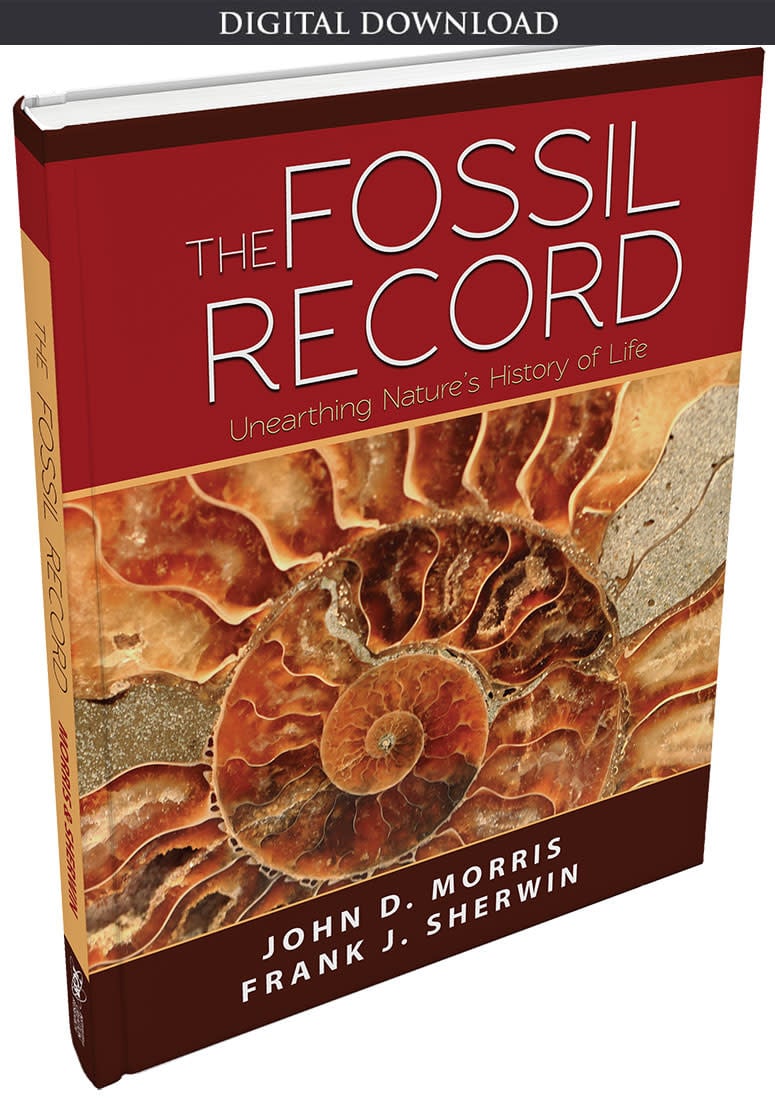



Earlier this year, ICR published a beautifully illustrated book entitled The Fossil Record: Unearthing Nature’s History of Life, co-authored by ICR Senior Science Lecturer Frank Sherwin and myself. Although it is not intended to be a textbook on paleontology, the study of fossils, it does provide important supplemental information that helps in understanding their basic message. It consists of two sections—a layman’s summary and an extensive appendix on supposed transitional fossils.
Both sections were written with Christian students in non-scientific majors in mind. We recognized that far too many Christian young people in high school and college leave the faith when they are confronted with an evolutionary interpretation of fossil evidence, having often received little training at home or in church to counter it. We desired to help stem those losses and provide Christians with practical answers they could use. The book’s main portion covers evolutionary claims that are likely to be discussed in entry level classes (where most of the damage is done), while the appendix gives more details that could be used for deeper study and in term papers. The goal is survival of Christian students in a hostile educational environment.
And make no mistake—mainstream American universities are hostile to Christian students. Many professors openly declare that their primary goal is forcing students to abandon theistic worldviews and adopt their own secularism. These losses are unnecessary, if the students only knew the facts about what the fossil record actually shows.
The Fossil Record doesn’t just show how a full understanding of the fossils contradicts evolution; it specifically supports creation and the Flood. It documents the sudden appearance of basic types, not a slow development of one type from some other type through transitional fossils. Fossils exhibit stasis, not the change that evolution requires. The animals represented in the fossil record typically died in catastrophic conditions of rapid water movement, not in uniform conditions. Fossilization occurred through rapid burial. The case is strong for the creation/Flood scenario. Only a willful commitment to naturalism would lead one to conclude evolution and uniformity instead.
In spite of this, a well-respected and well-funded group of scientists claiming to be Christians and Bible-believers have joined forces to teach that the Bible and evolution agree. Their view, which is essentially identical to the atheistic view, twists and shreds the Bible and is wholly improper for a Christian. I don’t have the authority to question anyone’s salvation, and am not doing so here, but isn’t this how the Bible describes false teachers?
This group, the BioLogos Forum, recently published a statement on transitional fossils that cited the examples of Tiktaalik, turtles, mammal-like reptiles, and whales as proof that evolution has taken place.1 Each of these subjects is extensively discussed in our book, and answers given. The authority cited for the article is BioLogos President Dr. Darrel Falk, a long-time biology professor at Point Loma University, the flagship Nazarene college in San Diego. His website identifies him as an active Sunday School teacher. I don’t know him personally, but I have met students who are atheists today because of the evolution-based secularism being taught at Point Loma. Surely there is something more profitable a scientifically-minded Christian can do than to teach students why they should doubt and disbelieve Scripture.
It is not my intention to pick a fight with other Christians, but to ward off the blows thrown in our direction and help young Christians survive indoctrination by theistic evolutionists with their faith intact. I call on Christians with scientific influence to align themselves with Truth, not the error of evolution.
Reference
- What does the fossil record show? The BioLogos Forum website, accessed September 21, 2010.
* Dr. Morris is President of the Institute for Creation Research.
Cite this article: Morris, J. 2010. Reading the Fossil Record. Acts & Facts. 39 (11): 17.