

Who: Isaac Newton
What: Father of Universal Gravitation
When: January 4, 1643 - March 31, 1727
Where: Woolsthorpe, a hamlet of Lincolnshire, England
Nature and Nature's laws lay hid in night:
God said, Let Newton be! and all was light.1
Sir Isaac Newton, perhaps the most influential scientist of all time, came from very humble beginnings. The Julian calendar places his birthday on Christmas 1642, before which his father, John Newton, died at the age of 36. He was born premature and possibly had Asperger syndrome, a form of autism, which could explain his later ability to intensely focus on specific subject matters.
His mother remarried and sent him at age three to live with his maternal grandmother. At 12 he was sent to The King's School, an educational institution for boys in Grantham, Lincolnshire. Biographer N. W. Chittenden recounts that the young Newton was not a good student at first. However, after losing in a fight against the student ranked just above him, he applied himself to his studies until not only did he outrank his offender, but everyone else in his class.
When he was 15, his mother was widowed again and for financial purposes removed him from school to manage a farm. He disliked the work and often neglected his duties, taking advantage of market trips into Grantham to read and study. His mother was persuaded to send him back to school to complete his education.
In 1661 at the age of 18, he entered Trinity College at the University of Cambridge. Newton took an interest in mathematics, overlooking the prominent study of the Greek philosopher Euclid and instead focusing on the relatively modern works of minds such as René Descartes, Galileo Galilei, John Wallis, and Johann Kepler.
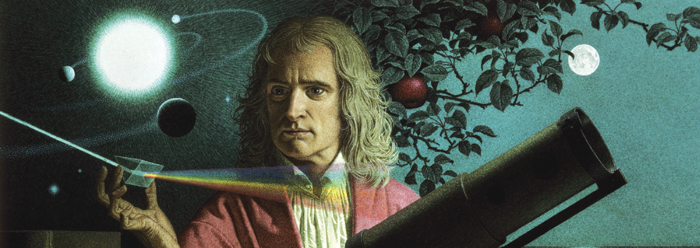
In 1665, the young scientist invented the generalized binomial theorem and began developing the mathematical theory that would later become calculus. He received his Bachelor of Arts degree later that year, shortly after which the university was closed as a precaution against the Great Plague. Newton returned to his home in Woolsthorpe to continue his work in calculus, optics, and the law of gravitation, as well as dabbling in some alchemy in the spirit of Robert Boyle's The Sceptical Chymist.
He returned to Cambridge in 1668 and earned Master of Arts recognition and the Lucasian Professor of Mathematics position a year later. The Royal Society took interest in his optics works, particularly his investigations into the refraction of light, as well as the reflecting telescope he invented (today known as a Newtonian telescope). Though his work received initial opposition, it paved the way for Newton's membership into the Royal Society in 1671, sparking the rapid rise of his reputation.
Newton hesitated to publicize his mathematical studies for fear of more opposition. But in 1687, he published the first edition of his Philosophiæ Naturalis Principia Mathematica (later translated in 1825 as The Mathematical Principles of Natural Philosophy), considered today to be the single greatest work in the history of science. In it, he described universal gravitation and the three laws of motion, derived from Kepler's Laws.
Though he was and still is renowned for his scientific pursuits, Newton was a serious student of the Bible and published several theological works. Even in his famed Principia, Newton exhibited his dedication to God.
This most beautiful system of the sun, planets, and comets, could only proceed from the counsel and dominion of an intelligent and powerful Being....This Being governs all things, not as the soul of the world, but as Lord over all; and on account of his dominion he is wont to be called Lord God "pantokrator," or Universal Ruler....2
Scientific inquiry, which then existed as Natural Philosophy, could not exist apart from "the Maker," according to Newton. In fact, science was the perfect realm in which to discuss God.
Since every particle of space is always, and every indivisible moment of duration is every where, certainly the Maker and Lord of all things cannot be never and no where....God is the same God, always and every where. He is omnipresent not virtually only, but also substantially; for virtue cannot subsist without substance.…It is allowed by all that the Supreme God exists necessarily; and by the same necessity he exists always and every where....And thus much concerning God; to discourse of whom from the appearance of things, does certainly belong to Natural Philosophy.3
Though he lived before Darwin, Newton was not unacquainted with the atheistic evolutionary theory on origins. He was convinced against it and wrote:
Blind metaphysical necessity, which is certainly the same always and every where, could produce no variety of things. All that diversity of natural things which we find suited to different times and places could arise from nothing but the ideas and will of a Being, necessarily existing.4
In the winter of 1692, Newton suffered the loss of a scientific manuscript 20 years in the making, which triggered a nervous breakdown that lasted almost two years. When he emerged from it, his scholastic work attracted royal attention, and he was appointed as warden and later master of the Royal Mint. Although the appointments were sinecures, he took his work seriously, eventually retiring from his professorship at Cambridge in order to focus on the Mint. He made significant contributions to currency reform and the convictions of counterfeiters and clippers (who clipped the edges of coins, devaluing the currency), crimes considered high treason. His work at the Royal Mint, rather than his scientific achievements, earned him knighthood from Queen Anne in 1705.
Other honors included being elected a member of the French Académie des Sciences in 1699, and becoming President of the Royal Society in 1703. He never married, and though he died without a will, he had already given much of his estate to his nieces and nephews. He also endowed a professorship at the University of Edinburgh in Scotland, and biographers noted that he gave liberally to the poor throughout his life.
Newton died in March 1727 and was interred at Westminster Abbey in London. Although in the popular imagination he is most closely associated with an apple and the law of gravity, Newton himself is quoted as saying, "Gravity explains the motions of the planets, but it cannot explain who set the planets in motion. God governs all things and knows all that is or can be done."5
References
- Epitaph for Newton's grave, composed by English poet Alexander Pope.
- Newton, I. General Scholium. Translated by Motte, A. 1825. Newton's Principia: The Mathematical Principles of Natural Philosophy. New York: Daniel Adee, 501. The Greek word pantokrator is most often translated as "Almighty" in the King James Version.
- Ibid, 505-506.
- Ibid, 506.
- Tiner, J. H. 1975. Isaac Newton: Inventor, Scientist and Teacher. Milford, MI: Mott Media.
* Ms. Dao is Assistant Editor.
Cite this article: Dao, C. 2008. Man of Science, Man of God: Isaac Newton. Acts & Facts. 37 (5): 8.