


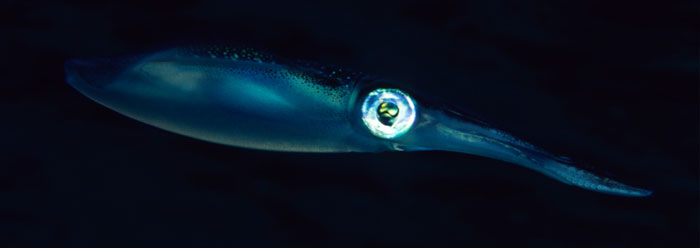
Imagine having skin that can mimic your surroundings, or even make you invisible. The Hawaiian bobtail squid (Euprymna scolopes) in the central Pacific has just such an astounding ability. It is designed with special proteins called reflectins that are as beautiful to view as they are amazing in their role.
The study of this function is a new discipline called biophotonics, which examines the use of electromagnetic radiation (light) in the living world. Biophotonic structures of the bobtail squid give it the ability to actually control how it reflects the sunlight that shines on its body. This unique trait reflects the Creator's glory while erecting yet another scientific roadblock to the evolutionary explanation of physical origins—for how could random genetic mutations lead to such intricate molecular structures?
According to a recent article in Nature Materials, the reflectin proteins "function in static and adaptive colouration, extending visual performance and intra-species communication."1 In other words, the biophotonic structures give the squid the ability to not only communicate with other squid, but to also change its coloration to blend with its surroundings and thus hide from predators. Reflectins in the skin mantle of the bobtail squid exhibit a quality known as variable reflectivity, which can make the creature at times virtually invisible. Once again, it is God's incredible creation that may pave the way for man to one day do the unthinkable--in this case, to possibly devise a cloak that can make something (or someone) virtually undetectable.
The near instantaneous color change of the squid is due to designed microscopic organs in the skin called chromatophores. Each chromatophore has a cell containing pigment and is surrounded by about 20 muscle fibers. Motor neurons enter these fibers, and neurons extending from the fibers go to cell bodies located in special lobes of the cephalopod brain. Thus, these are "neurally-controlled photonic structures."1
The reflectins seem to be unique to squid, coded for by at least six genes (specific DNA segments). In addition, researchers have found that the Hawaiian bobtail squid efficiently uses an exclusive bilobed ("two-lobed") light organ to its advantage. A species of bioluminescent bacteria called Vibrio fischera in the light organ receives nourishment from the squid. In return, the bacteria secrete a tracheal cytotoxin designed to control the development of the light organ. This cytotoxin is a small segment of the deleterious bacteria that causes whooping cough in humans. But perhaps the toxin served a more useful function, as we see in the squid,2 prior to the introduction of sin into God's creation, which led to the Fall and the current curse under which creation groans (Romans 8:22).
To conclude, not only is biophotonic design evidence for a clearly seen creation (Romans 1:20), but the Hawaiian bobtail squid in particular provides the creation scientist with a possible original benign function for disease-causing bacteria. Truly, God's creation declares--and reflects--His glory (Psalm 19:1).
References
- Kramer, R. et al. 2007. The self-organizing properties of squid reflectin protein. Nature Materials. 6:533-538.
- Sherwin, F. November 2005. Creation, Corruption, and Cholera. Acts & Facts. 34(11):5.
* Mr. Sherwin is Science Editor.
Cite this article: Sherwin, F. 2008. Squid Reflects Creation Evidence. Acts & Facts. 37 (4): 14.