


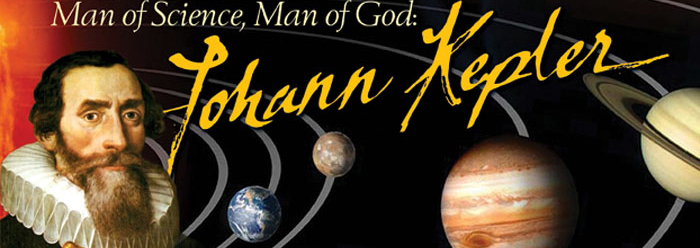
Who: Johann (or Johannes) Kepler
What: Father of Physical Astronomy
When: December 27, 1571 - November 15, 1630
Where: Born in Weil der Stadt, Württemburg, Holy Roman Empire, of German nationality
Johann Kepler developed a love for astronomy at an early age. He observed the Great Comet of 1577 when he was six and the 1580 Lunar Eclipse, events that no doubt fueled his curiosity and enthusiasm for science. Although he originally wanted to be a minister and studied theology at the University of Tübingen, Kepler accepted a position in 1594 as a mathematics and astronomy teacher at a Protestant school in Graz, Austria. He later became an assistant to Tycho Brahe, the court mathematician to Emperor Rudolf II. Upon Tycho's death, Kepler inherited his position, as well as his extensive archive of planetary observations.
Kepler is best known for discovering the three mathematical laws of planetary motion ("Kepler's Laws") that established the discipline of celestial mechanics. He also discovered the elliptical patterns in which the planets travel around the sun. At a time when the sun and other celestial bodies were still widely believed to circle the earth (geocentrism), Kepler defended Nicolaus Copernicus' theory that planets orbit the sun (heliocentrism) and sought to reconcile it with Scripture.1 He revolutionized scientific thought by applying physics (then considered a branch of natural philosophy) to astronomy (seen as a branch of mathematics).
An "unorthodox" Lutheran, Kepler had a deep love for Christ and the inspiration and authority of Scripture. He is frequently quoted as saying, "O God, I am thinking Thy thoughts after Thee." Strong theological convictions prompted him to find a connection between the physical and the spiritual, and his scientific discoveries led him to believe he had uncovered God's geometrical plan for the universe. In Kepler's view, the universe itself was an image of God, with the sun corresponding to the Father, the stellar sphere to the Son, and the intervening space to the Holy Spirit.
Life, however, held many trials for Kepler. His Protestant beliefs won him little favor with the Catholic church, and the Lutheran church shunned him for his sympathies with Calvinist beliefs. He was forced to relocate more than once to avoid persecution, as well as to escape political dangers from ongoing wars. He suffered the deaths of his first wife and several young children. In addition, fellow scientists did not immediately accept his scientific discoveries. Galileo Galilei and the French mathematician and scientist René Descartes ignored his 1609 work Astronomia nova (A New Astronomy). Even his mentor Michael Maestlin objected to his introduction of physics into astronomy.
Yet Kepler stayed true to his faith, as evident in his written works, and his scientific discoveries would eventually win him acclaim, legitimize the discoveries of his contemporary Galileo, and serve as a major influence on the scientists who came after him. His famous work Harmonies of the World (in Latin, Harmonices Mundi) begins:
I commence a sacred discourse, a most true hymn to God the Founder, and I judge it to be piety, not to sacrifice many hecatombs of bulls to Him and to burn incense of innumerable perfumes and cassia, but first to learn myself, and afterwards to teach others too, how great He is in wisdom, how great in power, and of what sort in goodness.2
At the end, Kepler concludes:
Purposely I break off the dream and the very vast speculation, merely crying out with the royal Psalmist: Great is our Lord and great His virtue and of His wisdom there is no number: praise Him, ye heavens, praise Him, ye sun, moon, and planets, use every sense for perceiving, every tongue for declaring your Creator…to Him be praise, honour, and glory, world without end. Amen.3
References
- An extensive chapter in Kepler's Mysterium Cosmographicum (The Cosmographic Mystery, the first published defense of the Copernican system) is devoted to reconciling heliocentrism with biblical passages that seem to support geocentrism.
- Kepler, J. 1619. "Proem." Harmonies of the World.
- "Epilogue Concerning the Sun, By Way of Conjecture," ibid.
* Ms. Dao is Assistant Editor.
Cite this article: Dao, C. 2008. Man of Science, Man of God: Johann Kepler. Acts & Facts. 37 (3): 8.