


Where Can We See Young-Earth Evidence? | The Institute for Creation Research

Where Can We See Young-Earth Evidence?

Download PDFDownload Where Can We See Young-Earth Evidence? PDF

Rocks and fossils do not come with labels informing us of their age. They must be understood in light of their geologic context, and interpreted within a worldview. Unfortunately, my evolutionary colleagues are often so dominated by uniformitarian brainwashing they can't objectively understand young-Earth evidence. Nevertheless, some of the evidence is clear and open for all to see.

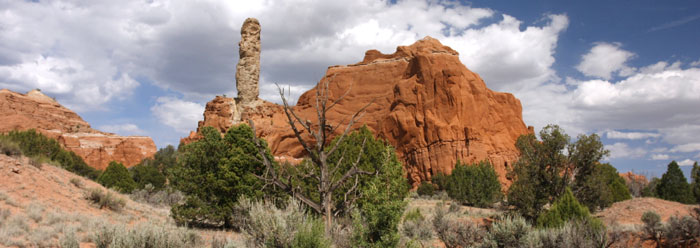
One such clear piece of evidence is in Kodachrome Basin State Park in Utah. Named by a former director of National Geographic magazine for its photographic beauty, it can be found near the better-known Bryce Canyon National Park. Here one can see numerous clastic "pipes" rising many feet into the air.

A clastic rock consists of eroded fragments of a previous rock. For instance, sandstone consists of sand grains, usually derived from a previously existing granitic source. When sand grains are deposited and cemented together it becomes a sandstone. These clastic pipes are sandstone, nearly identical with a deeply buried sandstone source.

Evidently a tectonic event fluidized an unconsolidated sand deposit, and squeezed it up like toothpaste into piercements in the overlying rock. Once emplaced as a liner "dike," or in this case a vertical "pipe," it hardened into resistant rock. Eventually the surrounding, more easily erodable rock was washed away, leaving only a vertical pipe.

The timing of the deposition, squeezing, and erosion provides the young-Earth argument. According to conventional dating methods, the pipes squeezed up some 150 million years ago, but the source sandstone bed is 175 million years old. Thus, the mother bed remained soft and unconsolidated for 25 million years before it squeezed up.

In the presence of a cementing agent to bind the grains together, which both the source and daughter pipes have, loose sand can harden into a sandstone in a short time, perhaps just years. The fact that the pipes exist at all is evidence that little time passed between deposition and squeezing. Thus, the millions of years postulated by old-Earth advocates never happened.

Cite this article: John D. Morris, Ph.D. 2006. Where Can We See Young-Earth Evidence?. Acts & Facts. 35 (7).

The Latest
NEWS
Chemical Clues Raise Questions About Early Animals
What if a simple sea sponge could spark a debate about the origin of animal life? A recent study suggests that some of Earth’s earliest animals...

NEWS
Alive with Christ
“Now if we be dead with Christ, we believe that we shall also live with him: knowing that Christ being raised from the dead dieth no more; death...

NEWS
April 2026 Wallpaper
"Ask the Lord for rain in the time of the latter rain. The Lord will make flashing clouds; He will give them showers of rain, Grass in the field...

NEWS
Does Earth Have a Twin?
A possible Earth-like planet 146 light-years away has recently been discovered by citizen scientists.1 The evolutionary community is cautiously...

NEWS
Giant Virus, Big Claims: Does Ushikuvirus Explain Complex Life?
A newly discovered giant virus called ushikuvirus has been described by conventional scientists as a possible clue to how complex cells evolved. But...

NEWS
Conventional Science Still Struggling to Exhume the Great Unconformity
The book of Genesis tells us about a global flood that occurred about 4,500 years ago, an event that began with the bursting of the fountains of the...

NEWS
Designed to Handle Oxygen: Lessons from Asgard Archaea
Oxygen gives cells energy. But oxygen can also harm cells. Any organism that uses oxygen must both harness the power and protect itself against being...

NEWS
New Species of Spinosaurus Supports Flood Catastrophe
Many people are fascinated with dinosaur discoveries—a new fossil, a new species, and the impressive size. But whenever we read a news article,...

NEWS
Adaptation Without Innovation: Rethinking Mutations and Design
What if mutations that seem helpful today become harmful tomorrow? That question sits at the center of a new genetics study published in Nature Ecology...

NEWS
More Soft Tissue in Archaeopteryx
Was the famous extinct fossil named Archaeopteryx a bird or an evolutionary link that led to birds? And how confident should scientists and others feel...