


Where Can We See Young-Earth Evidence? | The Institute for Creation Research

Where Can We See Young-Earth Evidence?

Download PDFDownload Where Can We See Young-Earth Evidence? PDF

Rocks and fossils do not come with labels informing us of their age. They must be understood in light of their geologic context, and interpreted within a worldview. Unfortunately, my evolutionary colleagues are often so dominated by uniformitarian brainwashing they can't objectively understand young-Earth evidence. Nevertheless, some of the evidence is clear and open for all to see.

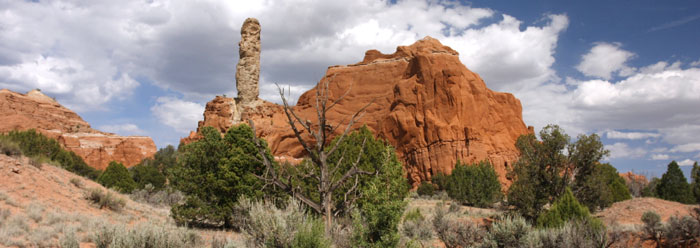
One such clear piece of evidence is in Kodachrome Basin State Park in Utah. Named by a former director of National Geographic magazine for its photographic beauty, it can be found near the better-known Bryce Canyon National Park. Here one can see numerous clastic "pipes" rising many feet into the air.

A clastic rock consists of eroded fragments of a previous rock. For instance, sandstone consists of sand grains, usually derived from a previously existing granitic source. When sand grains are deposited and cemented together it becomes a sandstone. These clastic pipes are sandstone, nearly identical with a deeply buried sandstone source.

Evidently a tectonic event fluidized an unconsolidated sand deposit, and squeezed it up like toothpaste into piercements in the overlying rock. Once emplaced as a liner "dike," or in this case a vertical "pipe," it hardened into resistant rock. Eventually the surrounding, more easily erodable rock was washed away, leaving only a vertical pipe.

The timing of the deposition, squeezing, and erosion provides the young-Earth argument. According to conventional dating methods, the pipes squeezed up some 150 million years ago, but the source sandstone bed is 175 million years old. Thus, the mother bed remained soft and unconsolidated for 25 million years before it squeezed up.

In the presence of a cementing agent to bind the grains together, which both the source and daughter pipes have, loose sand can harden into a sandstone in a short time, perhaps just years. The fact that the pipes exist at all is evidence that little time passed between deposition and squeezing. Thus, the millions of years postulated by old-Earth advocates never happened.


Cite this article: John D. Morris, Ph.D. 2006. Where Can We See Young-Earth Evidence?. Acts & Facts. 35 (7).

The Latest
NEWS
Did Scientists Find "6 Million-Year-Old Ice" in Antarctica?
by Jake Hebert, Ph.D., and Frank Sherwin, D.Sc. (Hon.)* A small portion of surface ice in Antarctica is called blue-ice areas (BIAs), and for good...

ACTS & FACTS
Dinosaur Ridge: Last Stand of the Dinosaurs
Paleontologists have ranked Dinosaur Ridge as the top dinosaur track site in North America.1 Run by the nonprofit group Friends of Dinosaur...

ACTS & FACTS
An Incredible Year of Advancement! 2025 Year in Review
Dr. Guliuzza at chapel in Corban University, Salem, Oregon The Institute for Creation Research had another incredible year advancing creation...

ACTS & FACTS
Creation Kids: Seasons
Hi, kids! We created a special Acts & Facts just for you! Have fun doing the activities while learning about the wonderful world God...

ACTS & FACTS
Why Is Natural Selection an Illusion?
Consider the following scenario. A population of organisms, let’s say racoons, lives in an environment somewhere on Earth and eats a variety...

ACTS & FACTS
Did Fossil Birds Live Longer than Today's Birds?
The Bible matter-of-factly states that humans living before and shortly after the Genesis Flood had centuries-long lifespans (Genesis 5 and 11). Yet...

ACTS & FACTS
Longevity Before the Flood
When gazing through a telescope, we see beauty so vast even the most powerful optics can’t see how far it spans. Trillions of stars are arranged...

CREATION PODCAST
The Complex Shape of DNA You’ve Never Been Taught | The Creation...
If you could stretch out the DNA in just one of your cells, it would be six feet long! And yet, it fits inside a space smaller than the tip of a needle...

ACTS & FACTS
Novel Orphan Genes Aid in Regulated Adaptation
Orphan genes (OGs) are genes that are unique to a specific kind of creature. This is especially significant when creatures that are considered evolutionary...

ACTS & FACTS
Sickle Cell Research Confirms TOBD Prediction: Directed Genetic...
Students of the creation-evolution debate know the changing explanations for how creatures originated and operate. Originally, the great minds of most...