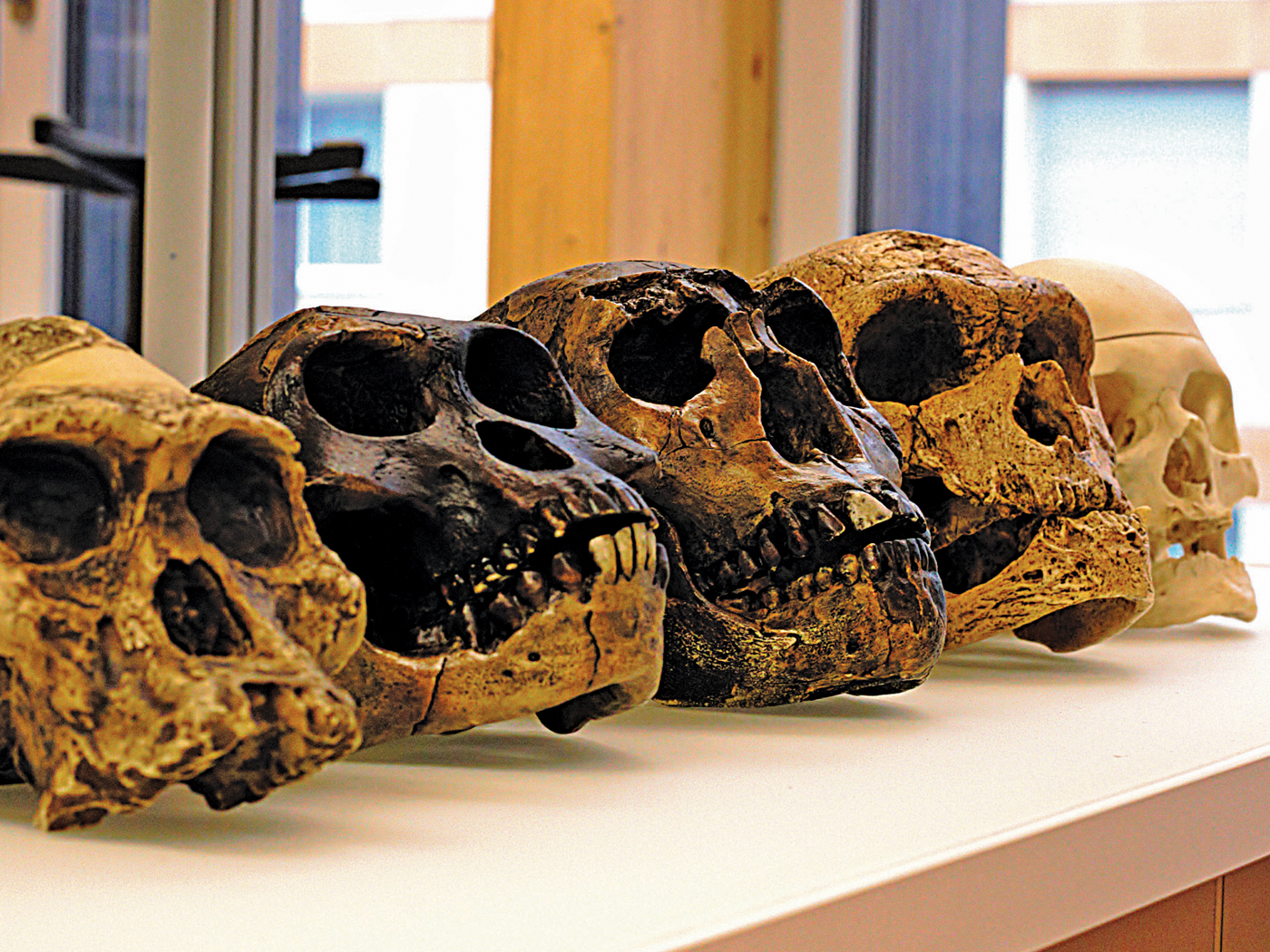



Evolutionists often speak of missing links. They say that the bridge between man and the apes is the "missing link," the hypothetical ape-like ancestor of both. But there are supposed missing links all over the evolutionary tree. For instance, dogs and bears are thought to be evolutionary cousins, related to each other through a missing link. The same could be said for every other stop on the tree. All of the animal types are thought to have arisen by the transformation of some other animal type, and at each branching node is a missing link, and between the node and the modern form are many more.
If you still don't know what a missing link is, don't worry. No one knows what a missing link is, because they are missing! We've never seen one. They're still missing. Evolution depends on innumerable missing links, each of which lived in the unobserved past and have gone extinct, replaced by their evermore evolved descendants.
While we don't really know what a missing link is (or was), we can know what they should be. As each type evolves into something else, there should be numerous in-between types, each stage gaining more and more traits of the descendant while losing traits of the ancestor.
If some type of fish evolved into some type of amphibian, there should have been distinct steps along the way of 90% fish/10% amphibian; then 80% fish/20% amphibian; etc., leading to the 100% amphibians we have today. You would suspect that unless evolution has completely stopped, there might even be some transitional links alive today, but certainly they lived and thrived for a while in the past before they were replaced.
Actually, evolutionists don't mention missing links much anymore. With the introduction of "punctuated equilibrium" in the early 70s, they seem to have made their peace with the lack of transitional forms in the fossil record. Their claim is that basic animal types exhibited "stasis" (or equilibrium) for a long period, but they changed rapidly (punctuation) as the environment underwent rapid change, so rapidly they had little opportunity to leave fossils. Thus we wouldn't expect to find transitional forms or missing links. Fair enough, but the fact is we don't find them. Evolution says they did exist, but we have no record of them. Creation says they never existed, and agree that we have no record of them.
Some of these gaps which should be filled in by missing links are huge. Consider the gap between invertebrates and vertebrate fish. Which marine sea creature evolved into a fish with a backbone and internal skeleton? Fish fossils are even found in the lower Cambrian, and dated very early in the evolution scenario. But there are no missing links, no hint of ancestors. The missing links, which should be present in abundance, are still missing!
Both creation and evolution are views of history, ideas about the unobserved past, and both sides try to marshal evidence in their support. Creation says each basic category of life was created separately, thus there never were any "missing links." Evolution says links existed whether or not we find them. The fact is we don't find them. The question is: which historical idea is more scientific, and which is more likely correct?
* Dr. Morris is President of the Institute for Creation Research.
Cite this article: Morris, J. 2006. What's a Missing Link? Acts & Facts. 35 (4).