


In 1889, Paris hosted the Exposition Universelle, a world’s fair celebrating the hundredth anniversary of the French Revolution. To mark the occasion, a design contest was held for a monument that would symbolize France’s progress and ingenuity. Among the many entries, one stood out, not just for its daring height but also for its surprising inspiration. Gustave Eiffel, a French engineer, looked not to classical architecture or ancient ruins but to the human body—specifically, the thigh bone.
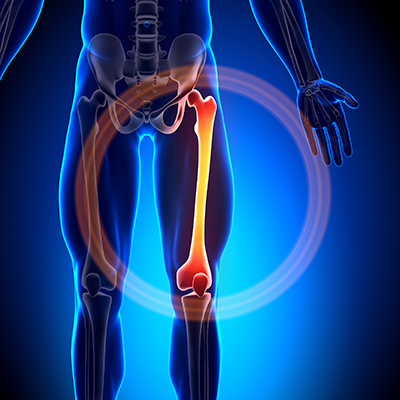
The femur, or thigh bone, is the largest and strongest bone in the human body. It connects the hip to the knee and supports much of our body weight. What fascinated Eiffel was the internal structure of the femur. Inside the rounded head of the bone, scientists had discovered a crisscross pattern of fibers called trabeculae. These fibers weren’t random. They followed the lines of stress and pressure that the bone experiences when we walk, run, or stand. In other words, the femur is naturally reinforced exactly where it needs to be.1
Eiffel saw this as more than an anatomical curiosity—it was a blueprint. Working from earlier research by paleontologist Hermann von Meyer and engineer Karl Culmann, Eiffel adapted the femur’s internal structure into a design for his tower. He used wrought iron instead of bone, but the principle was the same: a lattice of supports arranged to handle stress efficiently. The tower’s flared base mimicked the curved top of the femur, and its open framework echoed the trabecular pattern inside the bone.1
When Eiffel unveiled his design, many critics scoffed. Some called it an eyesore. Others predicted the tower would collapse under its own weight. But Eiffel trusted the design—after all, it had already withstood the test of time in the human body. Construction began in 1887 and was completed just two years later. At nearly 1,100 feet tall, the Eiffel Tower became the tallest man-made structure in the world at the time.2
More than 130 years later, the Eiffel Tower still stands strong and has survived storms, wars, and even the wear of millions of tourists. The monument’s strength and elegance continue to inspire engineers and artists alike.3 But perhaps its greatest legacy is the reminder that the best designs often come from nature, and nature, in turn, points to its own Designer.
The Eiffel Tower is more than an engineering marvel—it’s a tribute to the Creator’s wisdom. Indeed, as Scripture declares, “O LORD, how manifold are Your works! In wisdom You have made them all. The earth is full of Your possessions” (Psalm 104:24). Just as the femur was crafted to bear weight with grace and strength, so, too, was the tower that copied it. Modern engineers credit this biomimicry with fostering the tower’s remarkable longevity and resilience.4 In that sense, the Eiffel Tower could rightly be called “God’s Tower”—a monument not just to human achievement but to divine design.
References
- Adhikari, S. K. 2017. Stability of Eiffel Tower Is on the Basis of Structural Design of Human Femur and Its Mathematical Analysis. International Journal of Physics and Mathematical Sciences. 7 (2): 1–21.
- DeYoung, D. Leg Bone – Eiffel Tower. Discovery of Design. Posted on discoveryofdesign.com, accessed June 25, 2025.
- P., J. Effective Design of the Eiffel Tower. Educate For Life. Posted on educateforlife.org February 2, 2022.
- The Eiffel Tower: A 19th-Century Feat of Structural Engineering. McNeil Engineering. Posted on mcneilengineering.com September 7, 2021.
* Dr. Corrado earned a Ph.D. in systems engineering from Colorado State University and a Th.M. from Liberty University. He is a freelance contributor to ICR’s Creation Science Update, works in the nuclear industry, and is a Captain in the U.S. Naval Reserve.